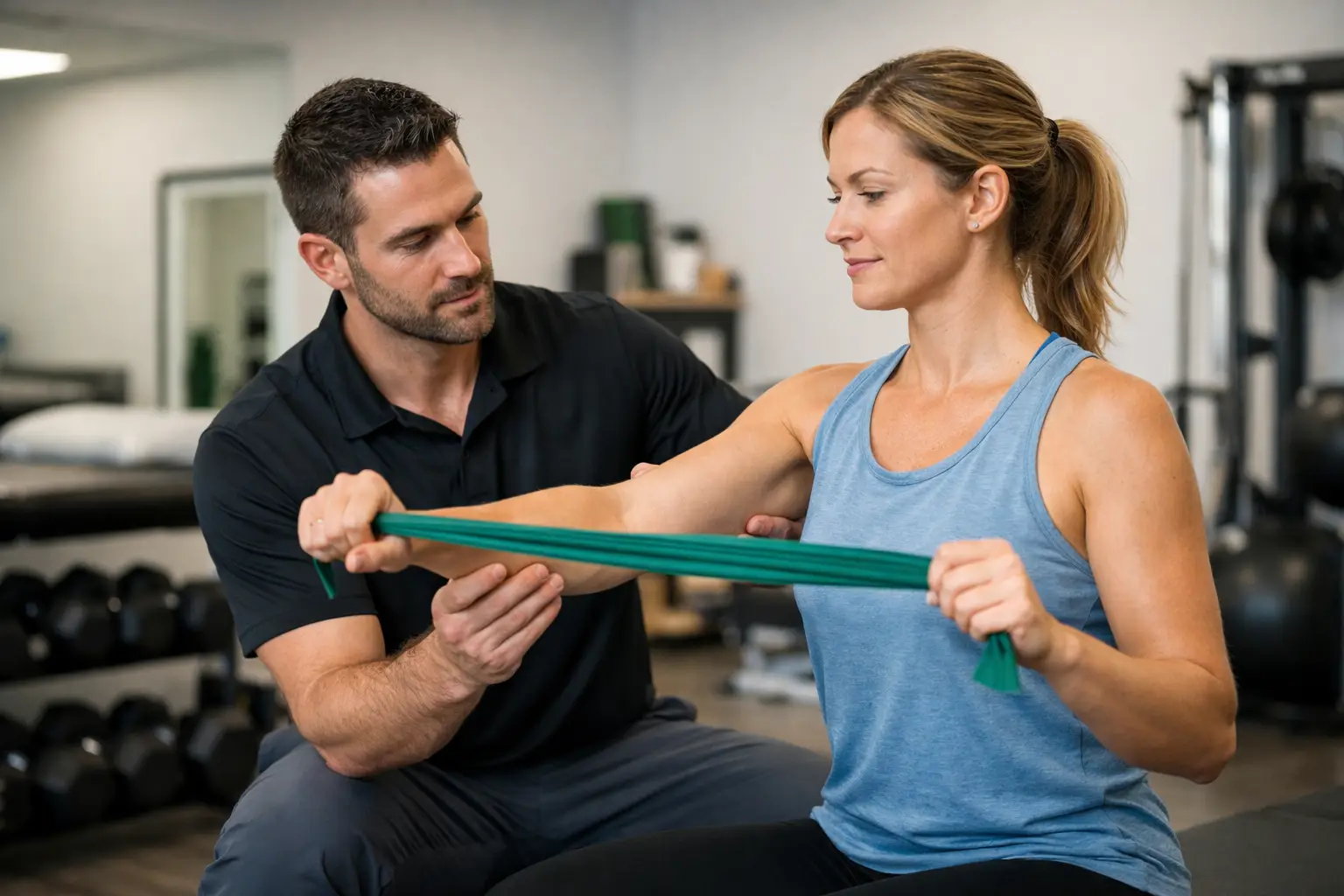
A sore Achilles that tightens up on your first few steps, an elbow that complains every time you grip a tool, or a knee that hurts after squats is not always a problem you can stretch or rest away. Tendon rehab Stoney Creek patients need should focus on more than settling pain for a few days. The goal is to rebuild the tendon’s capacity so it can handle the demands of work, training, sport, and daily life again.
Tendon pain can be frustrating because it often seems unpredictable. You may feel fine during a workout, then stiff and sore the next morning. Or you may stop activity completely, feel temporarily better, and have the same pain return as soon as you try to resume your normal routine. That pattern usually calls for a clearer plan, not simply more rest.
What tendon pain actually means
Tendons are strong connective tissues that transfer force from muscle to bone. They help you push off while running, lift a box, climb stairs, swing a golf club, and control a weight during strength training. Common tendon problems include Achilles tendinopathy, patellar tendinopathy at the front of the knee, tennis elbow, golfer’s elbow, rotator cuff-related tendon pain, gluteal tendinopathy at the side of the hip, and tendon pain around the foot and ankle.
The word tendinopathy is often used to describe persistent tendon pain and reduced tolerance to load. It does not automatically mean the tendon is torn, severely damaged, or permanently weak. In many cases, the tendon has become sensitive to demands that currently exceed its capacity. The solution is rarely to avoid all load forever. More often, it is about finding the right amount of load and building from there.
A sudden injury with immediate swelling, bruising, a pop, or major loss of strength is different. Those symptoms can indicate a more significant injury and deserve prompt medical assessment.
Common signs you may need tendon rehab in Stoney Creek
Tendon pain tends to be fairly specific. It is commonly felt at or near where the tendon attaches to bone, although symptoms can spread into the surrounding area. Stiffness after rest, pain at the beginning of activity that improves as you warm up, and soreness later that day or the following morning are all common patterns.
Your symptoms may show up when running hills, jumping, squatting, climbing stairs, gripping, lifting overhead, or spending a long shift on your feet. Some people also notice that a tendon hurts after a sudden jump in activity, such as returning to the gym after time away, adding running mileage, starting a new job, or taking on a busy weekend of home projects.
Pain alone does not tell us exactly what is happening. The location, activity pattern, strength, range of motion, recent training changes, and medical history all matter. That is why a proper assessment is more useful than guessing from a generic online exercise list.
Why tendon problems keep coming back
Tendon issues are often less about one bad movement and more about a mismatch between capacity and demand. A runner may increase distance and speed at the same time. A recreational lifter may add weight quickly after a break. A tradesperson may have weeks of repetitive gripping, carrying, kneeling, or overhead work without enough recovery.
Reduced calf, hip, shoulder, or forearm strength can contribute, depending on the tendon involved. Limited movement through a nearby joint may also change how you load an area, but it is rarely the whole story. Age, previous injury, sleep disruption, certain medications, metabolic health, and overall training volume can influence tendon recovery as well.
This is where the trade-off matters. Too much activity can keep symptoms reactive. Too little activity can reduce strength and leave the tendon less prepared when you return. Effective rehab sits between those extremes and adjusts based on your response.
How a tendon problem should be assessed
A useful tendon assessment begins with the question that matters most: what can you not currently do with confidence? That might be finishing a run, getting through a shift without elbow pain, training legs, walking the stairs, or simply getting out of bed without limping.
From there, an assessment should look at the painful area and the broader movement system. This can include testing tendon tenderness, range of motion, strength, load tolerance, balance, joint control, and the movements that reproduce your symptoms. Your clinician should also review your training, work demands, footwear where relevant, previous injuries, and what treatments or exercises you have already tried.
Imaging is not always necessary for tendon pain. Scans can be helpful in certain cases, especially after trauma or when symptoms do not fit a typical presentation, but an image does not always predict pain or function. Clinical findings and how your tendon responds to progressive loading often guide the rehab plan more effectively.
Treatment is useful when it supports rehabilitation
Hands-on care can help reduce pain, improve short-term movement, and make it easier to begin exercise. Depending on the presentation, treatment may include joint mobilization or manipulation, deep soft tissue therapy, instrument-assisted soft tissue therapy such as Graston, cupping, Class IV laser therapy, or shockwave therapy.
These tools are not standalone cures, and they should not be presented that way. Their value is in helping create a better window for movement and loading when appropriate. For example, a painful Achilles may tolerate calf strengthening more comfortably after symptoms have settled somewhat, while an irritated elbow may respond better to gripping and lifting progressions once pain is more manageable.
Shockwave therapy may be considered for some longer-standing tendon conditions, particularly when symptoms have not improved with an appropriate loading plan alone. It is not the first answer for every tendon problem, and it is not suitable for every person. The best choice depends on the tendon involved, your health history, symptom irritability, and your functional goals.
Progressive loading is the centre of tendon rehabilitation
A tendon gets stronger by being exposed to manageable, gradually increasing force. Early rehabilitation may start with isometric exercises - sustained muscle contractions that can help build tolerance and may reduce pain for some people. From there, the program usually progresses to controlled strength work through a fuller range of motion.
For an Achilles issue, that may mean progressing calf raises from two legs to one leg, then adding weight and eventually introducing hopping or running drills. For patellar tendon pain, the plan may build from controlled knee-dominant strength work toward jumping, landing, and sport-specific change of direction. For elbow tendinopathy, forearm and grip loading may be paired with adjustments to lifting, racquet sport, or job tasks.
The exact exercise is less important than the progression. A program should be specific enough to challenge the tendon but realistic enough to complete consistently. Pain during rehab is not always a sign that you are causing harm. Mild, tolerable symptoms can be acceptable in many cases, provided they settle appropriately and do not create a significant next-day flare-up. Your clinician can help set useful limits rather than asking you to avoid every uncomfortable movement.
Returning to training, work, and sport
The final stage of tendon rehab is not just being able to perform a few clinic exercises. It is being prepared for your real demands. If you run, your tendon needs running exposure. If you lift, it needs progressive resistance. If your job involves ladders, carrying, kneeling, or repetitive gripping, your plan should account for those tasks.
That return is often where recurring tendon pain begins. People feel better, skip the final strength progressions, and jump back to their previous volume too quickly. A better approach is to increase one major variable at a time, such as load, distance, speed, frequency, or complexity. This gives your body a chance to adapt and makes it easier to identify what is aggravating symptoms if they return.
At Ground Up Rehab, tendon care combines a thorough assessment, meaningful hands-on treatment when it is appropriate, and a progressive strength-based plan built around the activities you want to return to. Whether you are dealing with a recurring running injury, elbow pain at work, or knee pain in the gym, the aim is not to make you dependent on treatment. It is to help you build confidence in what your body can do.
If your tendon pain has lingered, keeps flaring when you return to activity, or is limiting the way you train, work, or move, book an assessment. A clear plan can turn a cycle of rest and recurrence into steady progress toward stronger movement.
