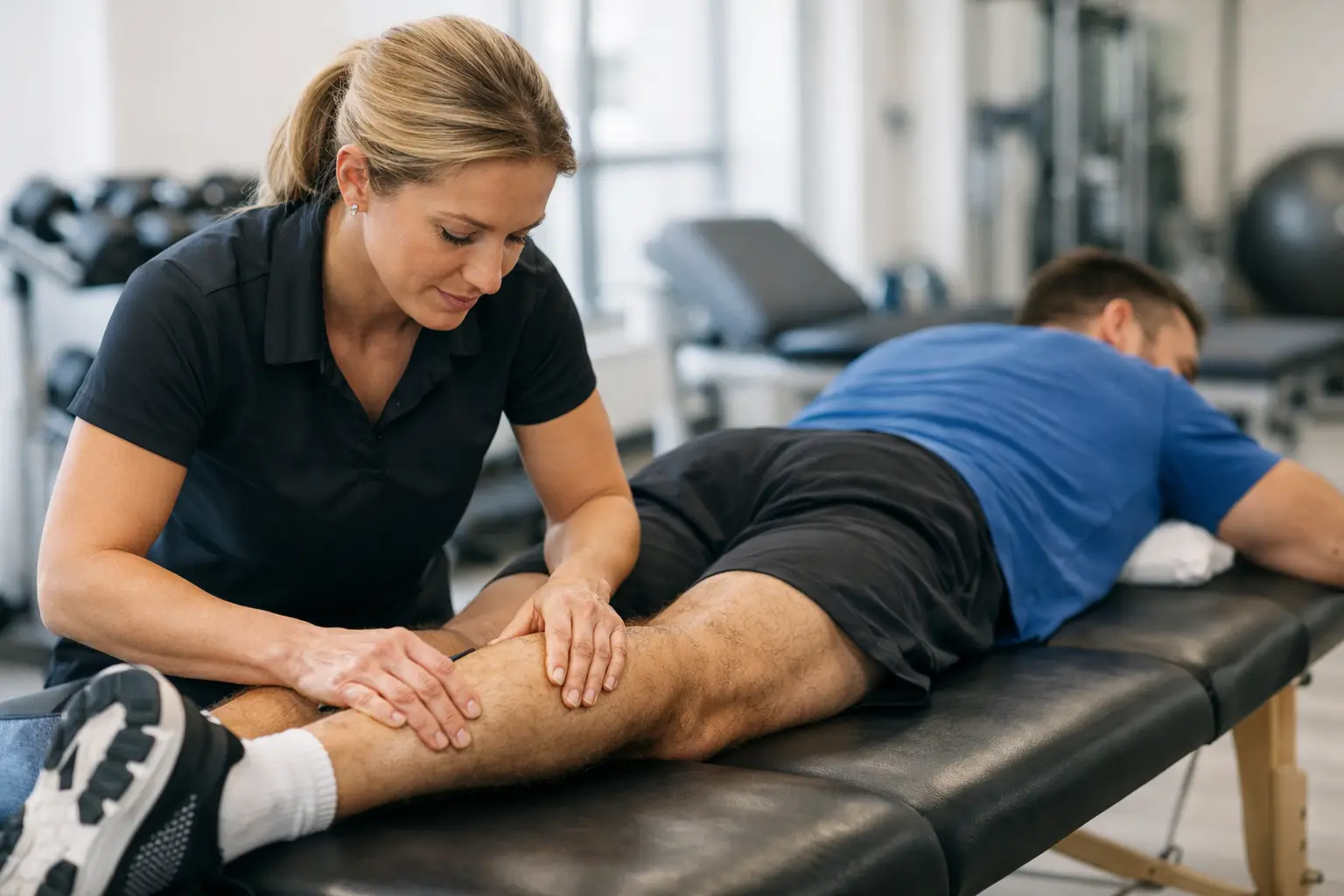
A calf strain can make an active person feel suddenly cautious. One sharp push-off while running, sprinting for a ball, climbing a hill, or driving out of a squat can leave the back of the lower leg tight, painful, and unreliable. For people searching for massage therapy Hamilton active adults can use after a calf injury, massage may be part of the answer - but it is not the whole plan.
A calf strain needs the right diagnosis, a sensible return-to-loading strategy, and treatment that matches the stage of healing. The goal is not simply to make the calf feel looser for a day. It is to restore its capacity to handle walking, stairs, training, work, running, and sport without recurring flare-ups.
What a calf strain actually is
The calf is made up primarily of the gastrocnemius and soleus muscles. Both help point the foot down, push the body forward during walking and running, and absorb force with every landing. The gastrocnemius crosses both the knee and ankle, while the soleus sits deeper and works especially hard during bent-knee positions, steady running, and endurance activity.
A calf strain occurs when muscle fibres are overloaded beyond what they can currently tolerate. This can range from a mild irritation with tightness and soreness to a more significant tear with bruising, swelling, weakness, and difficulty walking.
People often describe a sudden pull, grabbing sensation, or feeling as though they were kicked in the calf. Others have a slower onset pattern: the calf starts tightening during runs, feels sore after training, then becomes increasingly reactive with each session. Symptoms can overlap with Achilles tendon pain, referred pain from the low back, or more serious vascular concerns, so assuming every sore calf is a simple strain is not a smart approach.
Common symptoms in active adults
A calf strain may cause pain high in the calf, through the middle of the muscle, or closer to the Achilles tendon. You may feel pain when pushing off the ground, going up stairs, rising onto your toes, or stretching the ankle upward.
Milder strains may only hurt at faster speeds or during longer sessions. More substantial strains can make normal walking uncomfortable and may produce bruising over the following days. A lingering weakness during single-leg calf raises is also common, even after day-to-day pain improves.
That difference matters. Being able to walk without pain does not automatically mean the calf is ready for hill running, soccer, pickleball, heavy deadlifts, or a full shift on your feet.
Why calf strains keep happening
Most calf strains are not caused by one bad movement alone. They happen when the demand of an activity exceeds the capacity of the calf at that moment.
A sudden increase in running volume, a return to court sports after time off, more hill work, faster intervals, or a new lifting program can all create that mismatch. So can fatigue, reduced exposure to speed work, poor recovery from a previous strain, or returning to activity before calf strength has caught up.
For adults who spend much of the day sitting or standing at work, then train hard in the evening, the calf may also be asked to switch from low demand to high demand too quickly. That does not mean sitting caused the injury. It means the overall loading pattern needs to be considered.
Previous calf or Achilles issues are another factor. If the area has been painful before, you may unconsciously change how you walk, run, or load your ankle. Those changes can leave the calf doing too much work or avoiding the very loading needed to rebuild confidence and strength.
When calf pain should be assessed promptly
Not every calf ache requires urgent care, but some symptoms should not be managed as a routine muscle injury. Seek prompt medical assessment for calf swelling, warmth, redness, unusual tenderness, shortness of breath, chest pain, or symptoms that developed without a clear musculoskeletal trigger. These can be signs of a vascular issue rather than a strain.
An assessment is also worthwhile if you heard or felt a pop, cannot push off normally, have marked bruising, struggle to walk, or have pain close to the Achilles tendon. A complete Achilles rupture is less common, but it needs timely assessment.
For a less dramatic injury, get it checked if your calf keeps tightening every time you return to running or training, if it has not meaningfully improved over a couple of weeks, or if you are unsure what activity is safe. Repeated rest without a clear progression often turns a short-term strain into a recurring problem.
Massage therapy for Hamilton active adults with calf strain
Massage therapy can be useful when it is used for the right reason and at the right time. Early after a more acute strain, aggressive pressure directly into a painful area is usually not the priority. The tissue may be sensitive, and the first steps are often protecting the injury from unnecessary aggravation while maintaining comfortable movement.
As irritability settles, hands-on soft tissue treatment may help reduce guarding, improve short-term comfort, and make it easier to begin loading the calf. Depending on the presentation, treatment may include targeted soft tissue work, instrument-assisted soft tissue therapy, cupping, joint mobilization, or work to nearby areas that are contributing to how the ankle and lower leg are moving.
The trade-off is simple: hands-on care can help symptoms, but it does not replace rebuilding capacity. If massage makes the calf feel better but you immediately return to the same workload that caused the strain, the relief may be short-lived. The treatment should support rehabilitation, not become the rehabilitation.
How a calf strain is assessed
A useful assessment looks beyond the tender spot. At Ground Up Rehab, this may include discussing how the injury happened, what activities bring it on, and what your recent training or work demands have looked like. The calf, Achilles tendon, ankle, knee, and hip are assessed because each can influence lower-leg loading.
Movement testing may include walking, step-ups, squatting, ankle range of motion, calf raises, hopping, and running-related testing when appropriate. The findings help distinguish a likely muscle strain from tendon irritation, joint restriction, nerve-related symptoms, or another source of pain.
The point is not to chase a perfect label. It is to understand what the tissue can tolerate now, what is provoking it, and what needs to change for a confident return to activity.
Treatment should progress from pain control to capacity
The first phase is about calming the problem without complete shutdown. This may mean temporarily reducing sprinting, hills, jumping, or heavy loaded calf work while keeping tolerable walking, cycling, or strength training in the plan. Total rest can be useful briefly after a significant injury, but extended rest tends to reduce capacity further.
Once basic movement is more comfortable, calf loading starts at a level you can tolerate. This may begin with supported calf raises, isometric holds, and controlled seated work that targets the soleus. From there, rehabilitation progresses toward standing calf raises, heavier resistance, single-leg strength, and eventually faster or more elastic tasks.
For runners and field-sport athletes, the final stage must include preparation for the actual demands of the sport. That can mean repeated hops, acceleration drills, deceleration, incline work, cutting, or gradual exposure to faster running. A calf that handles slow strength work may still be underprepared for a sudden sprint.
Shockwave therapy or Class IV laser therapy may be considered in selected cases, particularly where symptoms suggest a tendon component or the area has become persistently painful. These tools can support a broader plan, but they are not standalone fixes. The load progression, movement strategy, and return-to-activity plan still do the long-term work.
Returning to training without guessing
A return to activity should be based on function, not just the calendar. Before resuming high-demand activity, you should generally be able to walk briskly, climb stairs, and perform controlled single-leg calf raises without meaningful pain or next-day flare-up. From there, activity is reintroduced in steps rather than by testing the calf with a full workout.
The exact pace depends on the severity of the strain, your sport, your injury history, and your current strength. A recreational runner may progress differently than a warehouse worker, golfer, or parent trying to keep up with weekend activities. Pushing too quickly can prolong the cycle, while being overly cautious for too long can leave the calf deconditioned.
If your calf keeps pulling, tightening, or limiting your training, an assessment can give you a clearer path than rest-and-hope. Book an assessment at Ground Up Rehab in Hamilton to identify what is driving the problem and build a plan that gets you back to moving with confidence.
