Achilles pain has a way of shrinking your world. A run becomes a cautious walk. Going up stairs feels irritating. Even the first few steps out of bed can become something you brace for. When pain has been hanging around, it makes sense to look for something that settles it down. But laser therapy evidence for Achilles tendinopathy needs to be understood in context: it may help some people manage symptoms, but it is not a replacement for rebuilding the tendon’s capacity.
What Achilles tendinopathy actually is
Achilles tendinopathy is persistent pain and reduced tolerance in the Achilles tendon, which connects the calf muscles to the heel. It commonly develops gradually rather than after one memorable injury. Runners, court-sport athletes, gym-goers, and people whose jobs involve lots of walking, stairs, ladders, or standing can all experience it.
The problem is usually not that the tendon is simply “inflamed” or damaged beyond repair. More often, the tendon has become less able to handle the load being placed on it. That load may be running mileage, hill work, repeated jumping, a new lifting program, long shifts on your feet, or a rapid return to activity after time off.
Pain can occur in the middle portion of the tendon, a few centimetres above the heel, or where the tendon attaches to the heel bone. These presentations overlap, but they are not identical. Insertional Achilles pain, at the heel attachment, often needs different exercise positioning and load progression than mid-portion tendon pain.
Common signs of Achilles tendinopathy
Achilles tendinopathy often causes stiffness and soreness at the start of the day or after sitting. The tendon may feel better once you are moving, then become more painful later that day or the morning after activity. Pressing on a specific section of the tendon can be tender, and some people notice thickening over time.
A useful clue is pain during activities that ask the calf and Achilles to store and release force: running, accelerating, jumping, climbing hills, or pushing off while walking quickly. That said, heel pain can also come from other structures, including the bursa near the heel, plantar fascia, or a bony prominence that irritates the area. A proper assessment matters before assuming every sore Achilles is tendinopathy.
Why it often keeps coming back
The most common driver is a mismatch between capacity and demand. A tendon may tolerate regular easy running but react when speed sessions, hills, and a longer weekend run are added in the same month. Someone returning to the gym may be fine with squats but become sore after suddenly adding plyometrics, skipping, and high-volume calf work.
Training load is not the only factor. Calf strength, ankle movement, footwear changes, recovery from a previous ankle injury, and how quickly someone progresses back to sport can all influence the picture. There is rarely one root cause hiding in a single body part. The goal is to identify the relevant contributors, then make the plan fit your actual work, training, and life demands.
Rest can calm an irritable tendon temporarily, but full rest for weeks often leaves it less prepared for the activity you want to return to. The better middle ground is usually adjusted activity combined with progressive loading.
Laser therapy evidence: useful, but not the whole plan
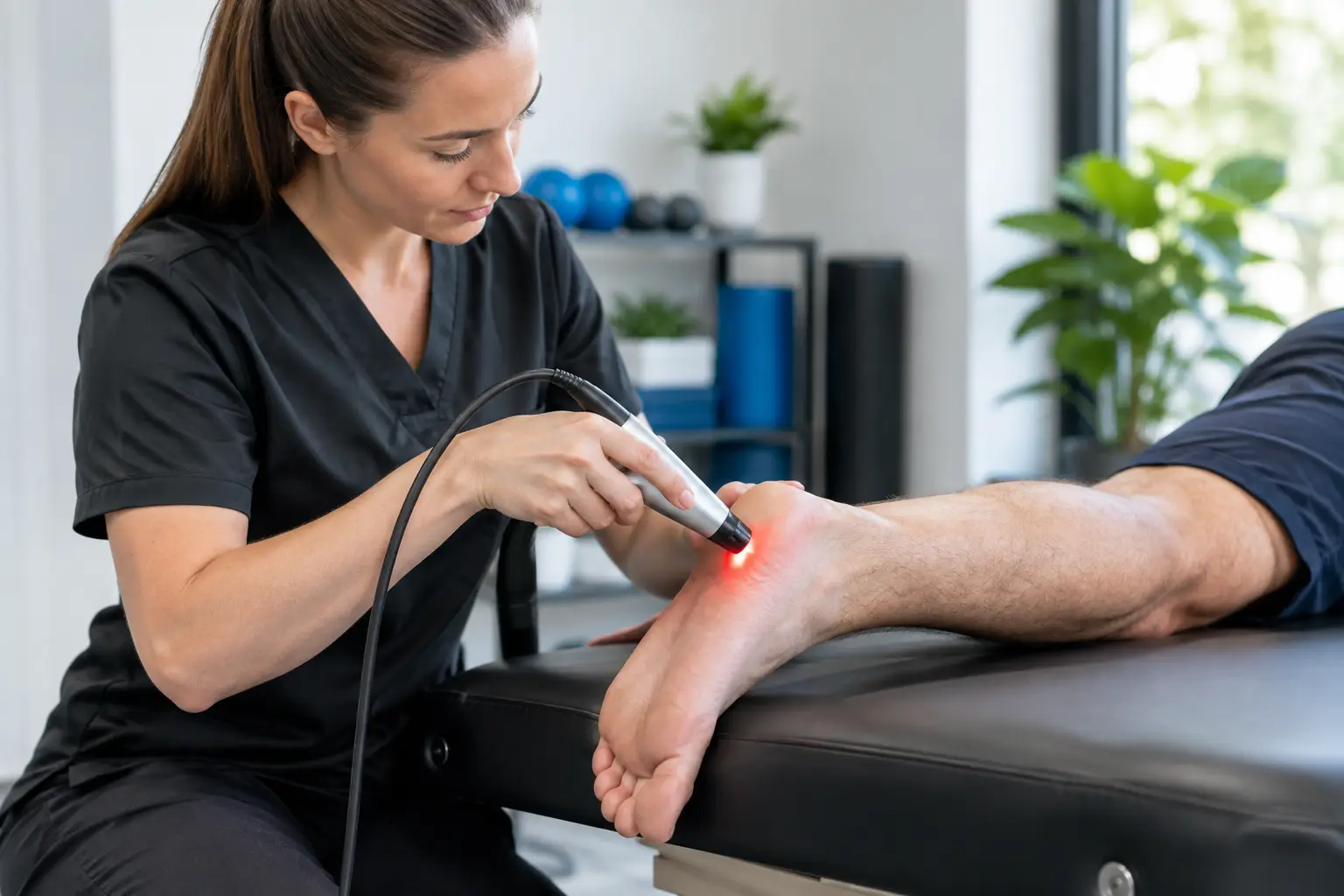
Class IV laser therapy is a form of photobiomodulation. It uses specific wavelengths of light intended to influence cellular activity and pain sensitivity in the treated area. In a clinical setting, it is commonly used as an adjunct when pain is limiting walking, work, or the ability to begin a meaningful rehabilitation program.
The research on laser therapy for tendinopathy is promising in some areas but not uniform. Studies vary substantially in the type of laser used, dosage, treatment frequency, tendon involved, severity of symptoms, and what other treatment participants received. That makes broad claims difficult. Positive results in one protocol do not mean any laser treatment will produce the same outcome.
For Achilles tendinopathy, low-level laser and higher-powered laser approaches may provide short-term improvements in pain or function for some people, particularly when paired with exercise-based rehabilitation. The most reasonable interpretation of the laser therapy evidence is not that laser heals an Achilles tendon on its own. It may help reduce pain enough to improve movement and participation in loading work, which is where longer-term capacity is built.
Laser is also not automatically the right choice for every case. If your pain is manageable and you are progressing well with a properly dosed loading plan, it may add little. If symptoms are highly irritable, progress has stalled, or pain is preventing you from completing useful rehab, it can be one practical tool within a broader plan.
Assessment should guide the treatment plan
A good Achilles assessment is more than locating the sore spot. It should clarify where the pain is, what activities trigger it, how symptoms behave over the next 24 hours, and what has changed in your training or workload.
At Ground Up Rehab, assessment may include observing walking and calf-raise mechanics, testing single-leg calf strength and endurance, checking ankle mobility, and looking at how your tendon responds to controlled loading. For runners or athletes, it may also include a conversation about recent volume, intensity, terrain, footwear, and return-to-sport goals.
This process helps determine whether the presentation looks like mid-portion Achilles tendinopathy, insertional tendon pain, a calf issue, heel irritation, or something requiring medical follow-up. Sudden severe pain, a pop, rapid swelling or bruising, marked weakness pushing off, or an inability to do a calf raise needs prompt assessment because an Achilles tear is a different problem.
The treatment that matters most: progressive loading
Tendons adapt to appropriately applied load. That is why a well-designed loading program remains central to Achilles rehabilitation. The starting point depends on irritability and function. For a very sensitive tendon, isometric calf work or supported calf raises may be enough. As tolerance improves, the program progresses toward heavier slow calf raises, single-leg strength work, and eventually faster, spring-like activities such as hopping, running, and jumping when those demands matter to your goal.
The progression should be specific. A tradesperson needs confidence with stairs, ladders, carrying, and long days on concrete. A runner needs gradual exposure to running volume, pace, hills, and speed. A basketball player needs to regain repeated jumping and change-of-direction tolerance. Generic exercises copied from a video may be a reasonable starting point, but they often fail because the dose and progression do not match the person or the sport.
Pain during rehab is not always a sign of harm. Mild, manageable discomfort can be acceptable in many tendon programs, provided symptoms settle appropriately and are not escalating week after week. The key is monitoring the response, especially the next morning, and adjusting load before a small flare-up becomes a prolonged setback.
Where hands-on treatment and laser may fit
Hands-on treatment can be useful when calf tightness, ankle stiffness, or pain sensitivity is making it harder to move and load comfortably. Depending on the assessment, this may include deep soft tissue therapy, joint mobilization, or instrument-assisted soft tissue therapy. These approaches should support the active rehabilitation plan, not replace it.
Class IV laser therapy may be considered alongside those options when symptom relief would help you walk more normally, tolerate calf loading, or progress through a return-to-running plan. Shockwave therapy is another modality sometimes considered in persistent tendon cases, but it also needs to be matched to the diagnosis, irritability, and overall plan. No passive treatment makes progressive loading optional.
A successful plan also respects what you need to keep doing. You may not need to stop training completely. You may need to temporarily reduce hills, sprinting, jumps, or running volume while maintaining strength work and other tolerable conditioning. Keeping some activity in your week is often better than moving from full training to none.
When to get Achilles pain assessed
Book an assessment if Achilles pain has persisted for more than a couple of weeks, repeatedly returns when you resume activity, changes the way you walk or run, or is stopping you from training, working, or keeping up with daily life. Earlier guidance can help prevent the familiar cycle of resting until it feels better, returning too quickly, and flaring it up again.
If your Achilles pain sounds familiar, a focused assessment can identify what the tendon is currently tolerating and build a path back to the activities you value. The aim is not to chase a quick fix. It is to help you move with more confidence and rebuild the strength your next run, shift, workout, or game actually demands.
