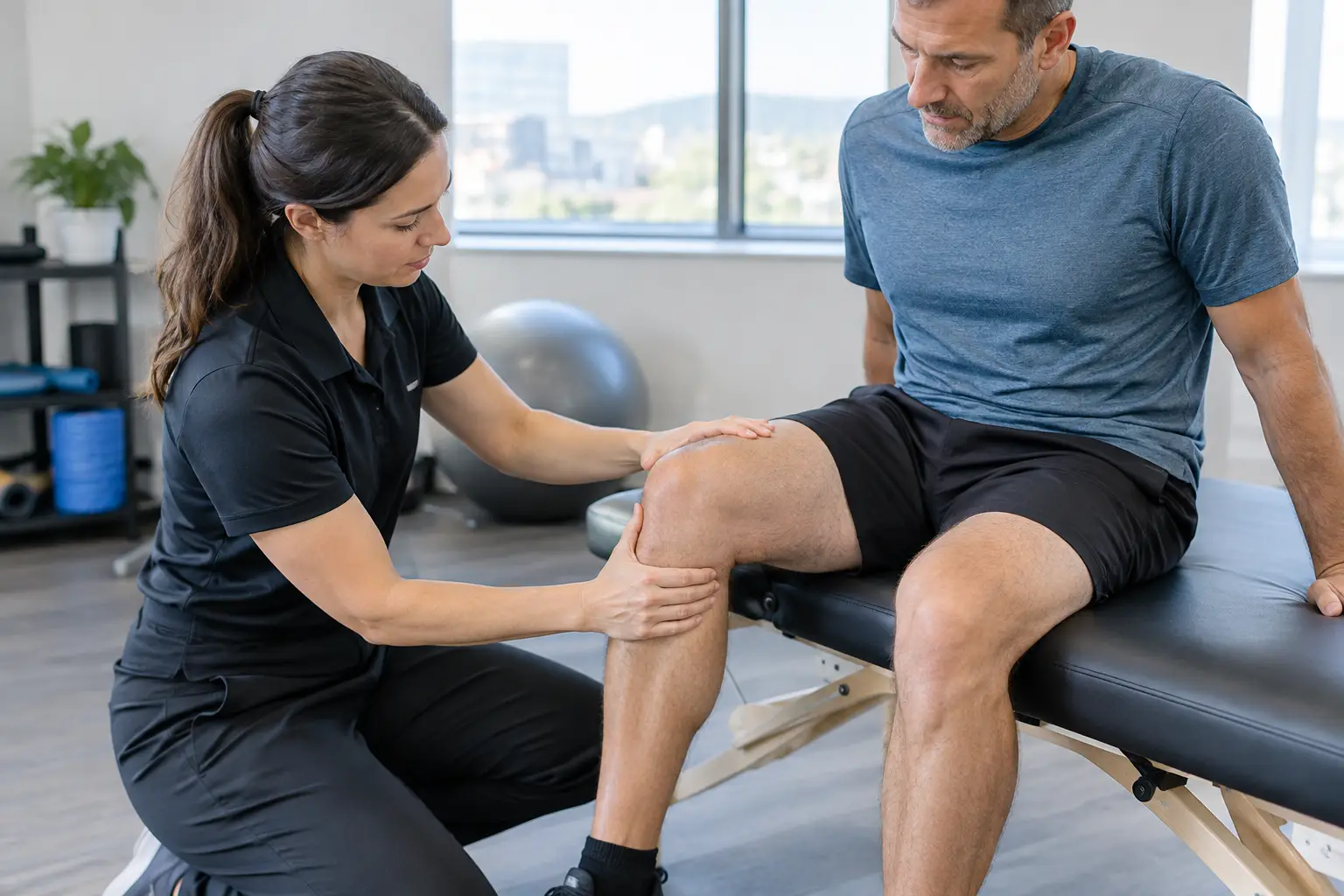
A squat that suddenly feels sharp, pain on the stairs at work, or a knee that swells after a weekend run can quickly change how you move. Knee pain Hamilton residents experience is not one single problem. It is a broad complaint that can involve the joint itself, the kneecap, tendons, cartilage, ligaments, or the way the hip, ankle, and knee are handling load together.
The useful question is not simply, “What treatment will make this go away?” It is, “What is my knee reacting to, and what does it need to tolerate the activities I want to do?” A clear assessment helps separate a short-lived irritation from a problem that needs a more structured rehabilitation plan.
What knee pain can feel like
Knee pain may be felt at the front of the knee, along either joint line, behind the knee, or just below the kneecap. The location matters, but it does not provide a complete diagnosis by itself. Symptoms can also change depending on whether you are walking, running, lifting, kneeling, cycling, climbing stairs, or getting up after sitting.
Common presentations include aching with longer walks, stiffness after inactivity, pain during squats or lunges, tenderness around the kneecap, clicking, swelling, or a sense that the knee is not trustworthy under load. Some people have a gradual onset with no memorable injury. Others can point to a twist, fall, awkward landing, or sudden increase in training volume.
A noisy knee is not automatically a damaged knee. Clicking or crackling without pain, swelling, locking, or loss of function is often not concerning. When those noises occur alongside pain or the knee repeatedly gives way, an assessment is more useful than guessing.
Common causes of knee pain in Hamilton
For active adults, one of the most common patterns is patellofemoral pain, often described as pain around or behind the kneecap. It may show up with stairs, running hills, deep squats, prolonged sitting, or a return to training after time away. The issue is often less about a kneecap being “out of place” and more about how much load the knee is currently able to tolerate.
Patellar tendinopathy is another common complaint, particularly in people who jump, play court sports, run, or lift regularly. It usually causes focused pain at the tendon just below the kneecap. It can be stubborn when training load rises quickly, but complete rest for long periods is rarely the whole answer. The tendon usually needs a gradual, well-managed return to loading.
Knee osteoarthritis is more common with age, previous injury, and accumulated joint stress, though symptoms and X-ray findings do not always match neatly. Stiffness, aching after activity, and difficulty with stairs or getting up from lower chairs are common. A diagnosis of osteoarthritis does not mean you need to stop being active. In many cases, appropriate strength work and load management can improve confidence and function.
Other possibilities include meniscus irritation, ligament injury, bursitis, quadriceps tendon pain, or pain referred from the hip or low back. A knee can also become sensitive after an old injury even when the original tissue damage has healed. This is why a diagnosis should not be based on one symptom, one internet test, or the location of pain alone.
Why symptoms often flare up
Knees are built to handle load, but capacity and demand need to be reasonably matched. A flare-up often follows a change such as adding more running kilometres, returning to the gym at previous weights, taking on extra shifts that involve stairs or kneeling, starting a new sport season, or spending a weekend doing more than usual.
Training volume is only one piece. Reduced hip, quadriceps, calf, or hamstring strength can change how demanding a task feels. Limited ankle motion may matter for someone who squats or runs, while poor recovery between demanding sessions can keep an irritated knee from settling. None of these factors automatically explains every case, but they are useful areas to assess rather than defaulting to rest and hoping for the best.
When knee pain needs prompt medical attention
Most knee pain is musculoskeletal and can be assessed conservatively, but some symptoms warrant more urgent medical evaluation. Seek prompt care after a significant injury if you cannot bear weight, the knee looks visibly deformed, or swelling comes on rapidly. A knee that is hot, red, very swollen, or paired with fever or feeling unwell also needs medical attention.
It is also wise to be assessed promptly if the knee is truly locked and cannot fully bend or straighten, if it repeatedly gives way after a traumatic incident, or if you have unexplained calf swelling, shortness of breath, or chest pain. Those symptoms are not problems to self-treat with exercises or passive care.
How knee pain is assessed
A good knee assessment starts with the story. When did symptoms begin? Was there an injury? What activities bring symptoms on, and what can you still do comfortably? Has the knee swollen, buckled, caught, or changed over time? The answers help determine whether the problem is likely driven by overload, trauma, joint irritation, tendon pain, or something that needs referral.
The physical assessment then looks beyond one painful spot. This may include knee motion, swelling, joint-line tenderness, ligament and meniscus screening where appropriate, strength, balance, squat mechanics, stair tolerance, gait, and relevant hip and ankle movement. For runners or lifters, the assessment should also consider the specific task that causes symptoms, not just a generic table-based exam.
Imaging can be helpful in some cases, especially after trauma or when symptoms do not match a straightforward presentation. It is not always the first or most useful step. Many imaging findings are common in people without pain, so results need to be interpreted alongside your symptoms, function, and goals.
Knee pain treatment should match the problem
Early treatment may involve adjusting the activities that are currently aggravating the knee. That does not always mean stopping everything. A runner may temporarily reduce distance or hills, while a lifter may modify depth, load, tempo, or exercise selection. The aim is to keep you moving within a tolerable range while building capacity back up.
Hands-on treatment can be useful when pain, stiffness, or muscle guarding is making movement difficult. Depending on the presentation, this may include joint mobilization, deep soft tissue therapy, Graston or instrument-assisted soft tissue therapy, or cupping. These tools can help create a window for more comfortable movement, but they are not a standalone cure for knee pain.
For selected tendon presentations, shockwave therapy may be considered as part of a broader rehabilitation plan. Class IV laser therapy may also be used in some cases to help manage symptoms. The right option depends on the condition, irritability, medical history, and response to care. The central work remains progressive rehabilitation, not chasing passive treatment session after session.
Progressive loading builds a more capable knee
Rehabilitation should reflect what you need your knee to do. Someone who wants to walk comfortably around the neighbourhood needs a different progression than someone returning to heavy barbell squats, recreational soccer, or a job that requires frequent kneeling and carrying.
A plan may begin with exercises that build tolerance without provoking a significant flare-up, then progress toward stronger quadriceps, hamstrings, calves, and hip musculature. As symptoms settle and capacity improves, rehabilitation should become more specific: step-ups and split squats for stair tolerance, controlled squatting for gym return, or hopping, deceleration, and directional work for sport.
Pain during rehabilitation is not always a sign of harm. For many knee conditions, some mild and temporary discomfort can be acceptable. What matters is the overall response: whether pain is escalating during the session, lingering significantly into the next day, causing swelling, or reducing function. The plan should be adjusted based on that response rather than following a rigid rule.
A practical approach to knee pain in Hamilton
At Ground Up Rehab, knee pain is approached as a movement and capacity problem to understand, not just a sore area to treat. The goal is to identify the likely drivers of your symptoms, use meaningful hands-on care when it supports progress, and build a plan that gets you back to work, training, sport, or everyday movement with more confidence.
If your knee has been limiting stairs, runs, squats, work tasks, or the activities you enjoy, booking an assessment can give you a clearer starting point. You do not need to wait until pain becomes severe before finding out what your knee can tolerate and how to build it back up.
