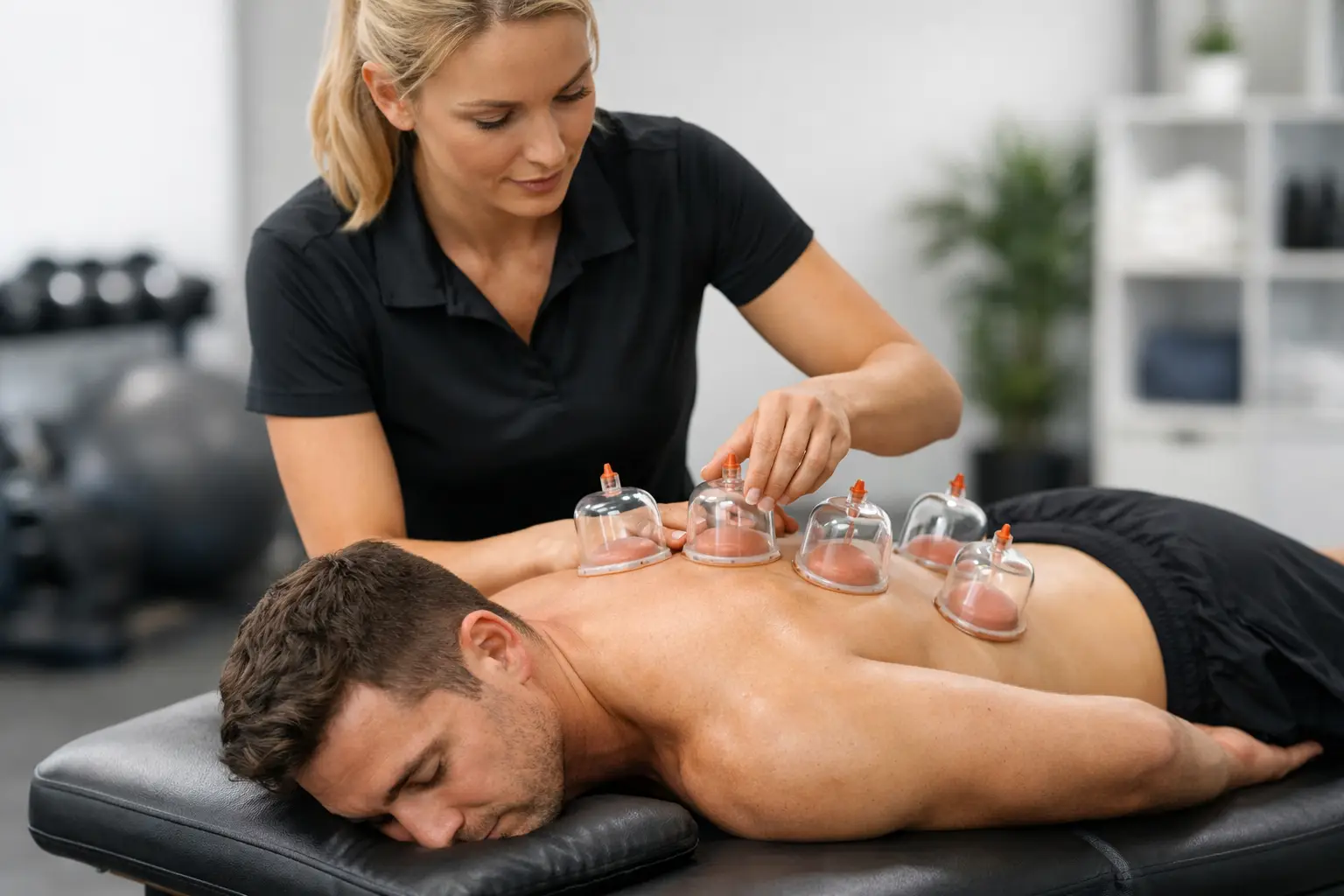
Achilles pain can make ordinary movement feel calculated. You notice it on the first few steps out of bed, while pushing off during a run, or when climbing stairs at work. So, is cupping good for recovery from Achilles pain? It can be a useful short-term tool for some people, but it is not the part of treatment that restores a tendon’s capacity to handle running, jumping, lifting, or long days on your feet.
For Achilles tendinopathy, the bigger goal is not simply to make the area feel looser. It is to identify what the tendon currently tolerates, calm an irritable flare-up when needed, and progressively rebuild strength and loading capacity.
What Achilles Tendinopathy Is
Achilles tendinopathy is persistent pain and sensitivity in the tendon connecting your calf muscles to your heel. It commonly develops in the mid-portion of the tendon, a few centimetres above the heel, although some people have insertional Achilles pain directly where the tendon attaches to the heel bone.
This is usually not a sudden tear. More often, the tendon has been asked to handle more load than it has recently been prepared for. That may happen after increasing running mileage, adding hill work, returning to court sports, starting a more demanding job, or pushing hard in the gym after time away.
Pain can also linger when people take complete rest for too long. Rest may settle symptoms temporarily, but a tendon that is not gradually reloaded can remain sensitive when activity resumes.
Common Signs of Achilles Pain
Achilles tendinopathy often causes stiffness and discomfort during the first steps in the morning or after sitting. The area may warm up during activity, then ache later that day or the next morning. Some people notice localized thickening, tenderness when pinching the tendon, or pain during calf raises, running, jumping, and uphill walking.
Symptoms alone cannot confirm a diagnosis. Pain at the back of the heel can also relate to irritation around the tendon, a heel bursa, a calf strain, or another issue. Location, loading history, strength testing, and movement assessment all matter.
Is Cupping Good for Recovery From Achilles Pain?
Cupping may help reduce pain sensitivity or the feeling of tightness in the calf for a short period. By applying suction to the skin and superficial tissues, it can create a strong sensory input that some people find relieving. It may also make it easier to move, tolerate calf work, or begin a rehabilitation session with less guarding.
That said, cupping does not repair damaged tendon fibres, remove scar tissue, flush out toxins, or replace strength training. The circular marks it leaves are temporary skin discolouration from small blood vessels near the surface, not evidence that a deeper problem has been fixed.
For a person whose calf is highly guarded after a painful flare-up, cupping may be reasonable as one component of care. For someone expecting it to solve months of recurring Achilles pain without changing their loading plan, it is unlikely to deliver lasting results. The benefit depends on whether it helps you do the work that actually builds recovery.
When Cupping May Be Useful
Cupping can be considered when calf tightness or pain sensitivity is making it difficult to start movement or exercise. It may be paired with hands-on soft tissue treatment, mobility work, or a gradual calf-loading session. Some active adults also find it useful between training blocks when symptoms are mild but the calf feels restricted.
The response should be assessed honestly. If you feel better for an hour but cannot tolerate any more walking, calf raises, or running over the following days, it has not meaningfully changed the problem. Temporary relief is still useful, but it should not be confused with tendon rehabilitation.
When It Is Not the Right Focus
Cupping is not a priority if the main issue is a clear mismatch between your current capacity and your weekly training load. For example, a runner who suddenly doubles mileage, adds hills, and starts speed work needs a smarter loading plan more than another passive treatment.
It should also be avoided over broken or irritated skin, active infection, or areas that bruise easily. People using blood-thinning medication or with certain medical conditions should discuss suitability with a qualified clinician first. If the marks are not practical for an upcoming event, work requirement, or social setting, that is a reasonable trade-off to consider.
Why Achilles Pain Keeps Returning
The Achilles tendon stores and releases force with every step, especially during faster walking, running, jumping, and cutting. It becomes more vulnerable when demand rises faster than capacity. The trigger is not always dramatic. A new commute involving more walking, a busy stretch of shifts, a change in footwear, or returning to recreational sport can be enough.
Calf weakness can contribute, but so can poor tolerance to repeated loading, reduced ankle movement, limited recovery between demanding sessions, and an abrupt jump in training volume. Insertional Achilles pain needs additional consideration because deep heel-drop exercises can aggravate compression at the attachment site.
This is why generic online exercises often disappoint. The right starting point depends on whether the tendon is highly reactive, where the pain is located, and what activities you need to return to.
When Achilles Pain Needs Assessment
Book an assessment if pain is limiting work, walking, training, or sport; if morning stiffness keeps returning; or if you have tried resting, stretching, massage, or random exercises without lasting change. Earlier assessment can help prevent a manageable tendon problem from becoming a long interruption to activity.
Seek urgent medical attention if you felt a sudden pop in the back of the ankle, have major swelling or bruising, cannot push off or perform a calf raise, or suspect an Achilles rupture. Sudden redness, warmth, fever, or unexplained calf swelling also needs prompt medical assessment.
A Better Recovery Plan Than Passive Treatment Alone
A useful assessment looks beyond the painful spot. It considers your activity history, recent workload changes, footwear, ankle movement, calf strength, single-leg control, and the specific tasks that provoke symptoms. For runners, that may include hills and speed work. For tradespeople, it may be ladder use, carrying loads, or long hours on concrete.
Treatment may include hands-on therapy, joint treatment where appropriate, or tools such as cupping, Graston/instrument-assisted soft tissue therapy, Class IV laser therapy, or shockwave therapy in selected cases. These can help manage pain and improve tolerance to movement. None should be presented as a standalone cure.
The foundation is progressive loading. Early on, this may mean isometric calf holds or controlled calf raises within a tolerable range. From there, rehabilitation builds heavier calf strength, single-leg capacity, and eventually faster, more elastic loading such as hopping, running drills, or sport-specific work. Progress is based on your symptoms during activity and your response over the next 24 hours, not on forcing through pain or avoiding all discomfort.
A small amount of manageable discomfort can be acceptable in tendon rehab. Sharp pain, rapidly escalating symptoms, or substantially worse morning stiffness the next day means the dose likely needs adjustment. This practical middle ground is what helps people continue moving without repeatedly setting themselves back.
How Ground Up Rehab May Approach Achilles Pain
At Ground Up Rehab in Hamilton, care for Achilles pain is built around a clear assessment and a plan that fits your actual life. If cupping or other hands-on treatment helps reduce symptoms enough to move and load more confidently, it can have a place. The main focus remains restoring calf and tendon capacity so you can return to running, training, work, or sport with more confidence.
If the Achilles pain you are dealing with sounds familiar, book an assessment and get a plan built around the demands you want your body to handle again.
