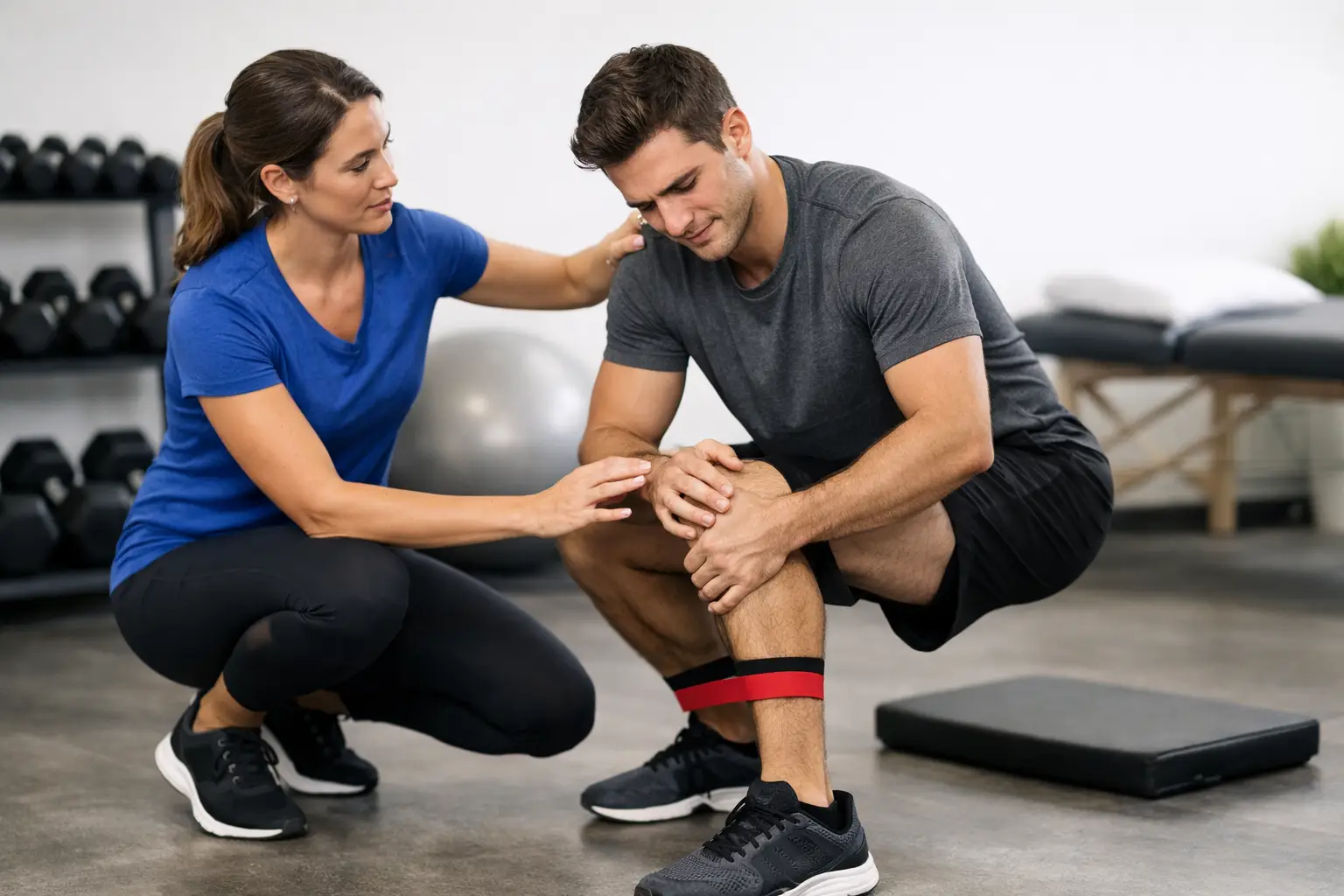
A squat that hurts is not automatically a squat you need to stop forever. But repeatedly forcing through sharp, escalating, or lingering knee pain is rarely a productive plan either. Knowing how to modify painful squats starts with identifying what the pain is telling you, reducing the parts of the movement your knee cannot currently tolerate, and rebuilding capacity rather than avoiding squats indefinitely.
For many active adults, squat-related knee pain falls under the broad umbrella of patellofemoral pain - pain felt around or behind the kneecap. It can make training, stairs, getting up from a chair, and even a long day on your feet frustrating. The good news is that most people can work back toward meaningful squat depth and strength with an individualized, progressive approach.
Why knee pain can show up during squats
Patellofemoral pain is a common presentation in people who squat, run, cycle, play field sports, or have recently increased their activity. It is often described as an ache, pressure, pinching, or discomfort at the front of the knee. Some people notice clicking or grinding too, although noise by itself is not usually a sign of damage.
A painful squat does not point to one certain diagnosis. Pain at the front of the knee may be related to patellofemoral pain, while pain directly below the kneecap may suggest patellar tendon irritation. Pain along the joint line, significant swelling, locking, a new inability to bear weight, or pain after a substantial twist or fall needs a more careful assessment.
The squat itself is not necessarily the problem. It is a demanding movement that requires the knee, hip, ankle, trunk, and surrounding muscles to share load. Symptoms commonly appear when the total demand exceeds current capacity. That can happen after increasing weight, volume, depth, frequency, running mileage, sport participation, or even physically demanding work.
Sometimes the change is obvious: you added heavy front squats after time away from the gym. Other times, capacity has gradually dropped because of previous knee pain, a period of reduced activity, poor sleep, or a training plan that has not allowed enough recovery. Technique can matter, but there is no single perfect squat shape that fits every body.
How to modify painful squats without losing progress
The goal is not to find a completely painless life where your knee is never challenged. The goal is to find a squat variation and training dose that is tolerable now, then progress it deliberately. Mild discomfort can sometimes be acceptable during rehabilitation if it stays controlled and settles back to baseline within 24 hours. Sharp pain, worsening pain set after set, swelling, limping, or symptoms that are notably worse the next day are signs the current dose is too high.
Adjust depth before abandoning the movement
Deeper squats generally place more demand on the knee. If pain starts near the bottom position, reduce depth temporarily. A box squat to a height that stays comfortable can be useful because it gives you a consistent target without turning the movement into a complete rest.
This is not a permanent rule that deep squats are bad for knees. It is simply a way to match the exercise to your current tolerance. As symptoms settle and strength improves, the box can gradually get lower.
Reduce load, reps, or frequency
A heavy set of five, three hard sets of 12, and a high-volume conditioning workout can all irritate the same knee for different reasons. Reducing the bar weight is often the first useful modification, but it is not the only one.
You may need fewer sets, fewer repetitions, more rest between sessions, or a slower return to training after a flare-up. For example, dropping from four squat sessions per week to two may be more effective than changing every detail of your stance. The right adjustment depends on what is driving symptoms.
Change the squat variation
Different squat variations distribute load differently. A goblet squat, supported squat holding onto a rack, or counterbalanced squat with a light weight held in front may feel more comfortable than a barbell back squat. Support can improve balance and allow you to control depth and tempo more confidently.
Some people tolerate a wider stance or a slightly more forward torso position better. Others are more comfortable with a heel-elevated variation because limited ankle movement is forcing an early heel rise or an unstable squat pattern. These are options to test, not universal corrections.
If one variation hurts less, it is a useful training entry point. It does not mean the painful variation is permanently off limits. It gives you a place to keep building leg strength while you work toward the movement you want to return to.
Use tempo and isometrics strategically
Slowing the lowering phase can reduce the urge to drop into the bottom position and improve control. A three-second descent with a comfortable range is often enough. It may also reveal whether pain is linked to a particular portion of the movement.
Isometric work, such as a wall sit or Spanish squat hold, can be a useful bridge for some knee pain presentations. These exercises are not magic, and they are not right for everyone. They can, however, allow the quadriceps to work at a manageable intensity when full squat repetitions are too aggravating.
Common mistakes when modifying painful squats
The most common mistake is replacing squats with complete rest for weeks or months. Rest can calm a flare-up, but it does not rebuild your ability to tolerate knee load. When you eventually return to the same weight, depth, and volume, the pain often returns.
The opposite mistake is treating pain as something to defeat. A painful session followed by a swollen or more irritable knee the next day is not proof of a productive workout. It is feedback that the load needs adjusting.
Another issue is endlessly chasing a technique cue. “Knees out,” “sit back,” and “keep your knees behind your toes” may help some people organize a movement, but they are not universal solutions. Healthy knees can move forward over the toes during a squat. The more useful question is whether your current movement, depth, load, and volume are appropriate for your body right now.
Build back knee capacity outside the squat rack
Modifying the squat is only one part of rehabilitation for patellofemoral knee pain. A stronger return usually includes progressive work for the quadriceps, hips, calves, and trunk, selected around your symptoms and goals.
Depending on your presentation, this may include split squats, step-ups, leg press, knee extension work, deadlift variations, or controlled single-leg exercises. The best starting exercise is not necessarily the most advanced one or the one that looks most athletic. It is the one that gives you a clear training effect without producing an unhelpful flare-up.
Progressive loading matters. If a box squat with bodyweight is comfortable, the next step might be a lower box, a goblet squat, more repetitions, or modestly more weight. Only change one or two variables at a time so you can understand what your knee is responding to.
A training log can help. Note the exercise, depth, load, sets, repetitions, pain during the session, and how the knee feels later that day and the following morning. Patterns become clearer quickly, especially when symptoms have felt unpredictable.
When painful squats need an assessment
Book an assessment if knee pain is persistent, repeatedly returns when you try to train, limits work or daily activity, or has not improved with sensible load changes. Assessment is particularly important if there is substantial swelling, the knee locks or gives way, you cannot fully straighten it, pain follows a significant injury, or you have fever, redness, or unexplained calf swelling.
A thorough musculoskeletal assessment should look beyond the painful rep. At Ground Up Rehab in Hamilton, that means discussing your training history, recent workload changes, symptoms, previous injuries, and goals, then assessing the knee alongside relevant hip, ankle, and strength factors. The aim is not to hunt for one flawed body part. It is to understand what is currently limiting your tolerance and create a plan that fits your actual life.
Hands-on treatment such as joint mobilization, soft tissue therapy, or instrument-assisted soft tissue work may be used when it helps reduce symptoms or improve movement options. These approaches are not standalone fixes. Their value is in helping you move into the rehabilitation work that builds lasting capacity. Your plan should progress from tolerable loading to the strength, depth, speed, and volume required for your gym training, work, or sport.
You do not need to earn your way back to squats by avoiding your knees. If knee pain during squats sounds familiar, book an assessment and get a clear plan to load with confidence again.
