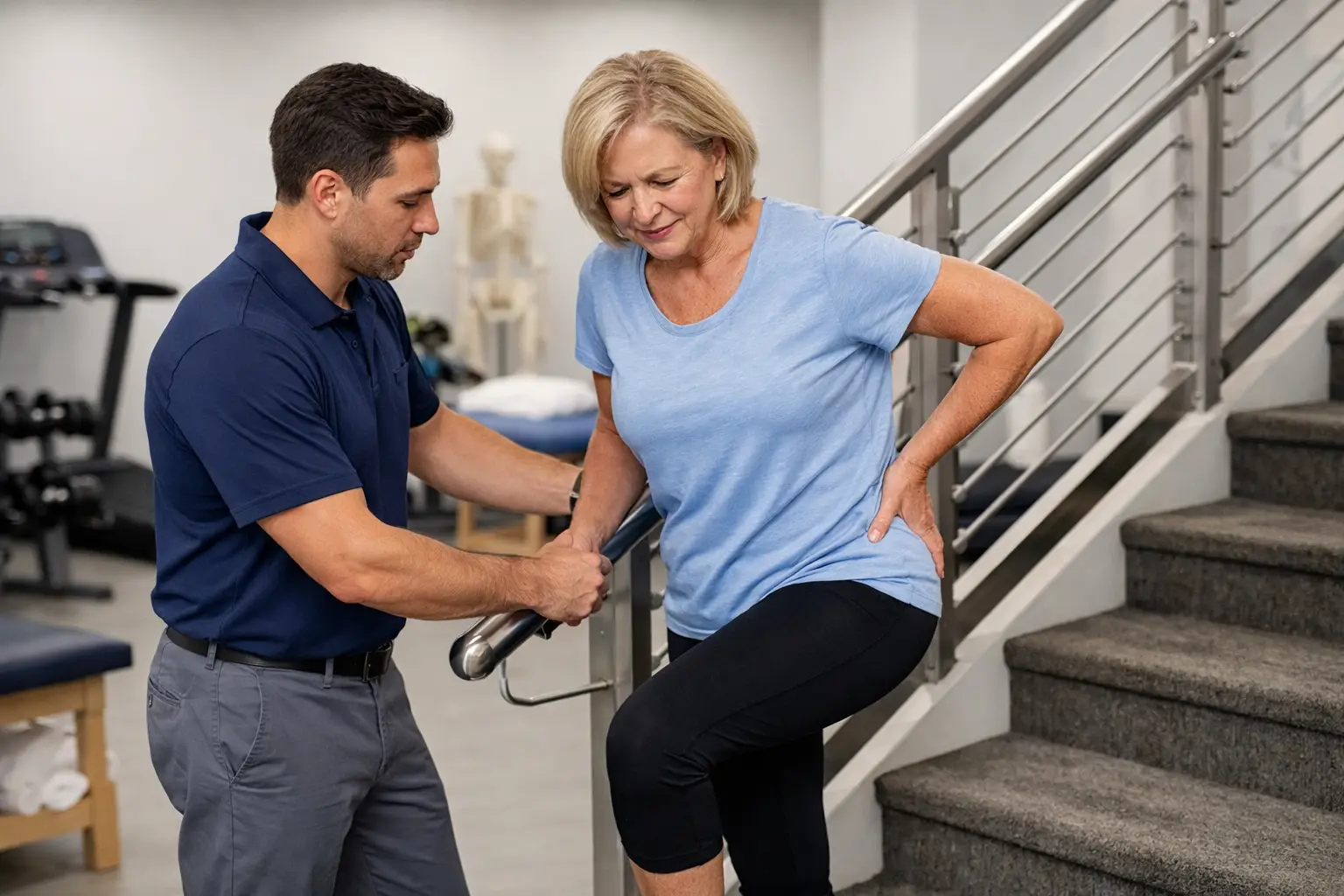
A flight of stairs can be an effective reality check for a painful hip. Hip pain walking upstairs is not always a sign of one specific injury, but it does tell you that your hip and surrounding muscles are struggling with the combination of bending, loading and single-leg control that each step requires. If you can walk on flat ground but feel a sharp pinch, deep ache or weakness on stairs, it is worth looking beyond simply “tight hips.”
Stairs demand more from the body than level walking. The hip has to flex as you lift your leg, then extend and stabilize your pelvis as you push your body weight upward. A problem involving the hip joint, the gluteal tendons, the muscles at the front of the hip, the low back, or even the knee can become much more noticeable in that position.
Why does hip pain show up on stairs?
Going upstairs increases the load through the hip and requires meaningful work from the glutes, quadriceps and hip flexors. It also places the hip in a deeper bend than normal walking. That combination can expose an irritated structure or a movement strategy that is no longer working well.
The exact location of pain matters. Pain deep in the groin or front of the hip may behave differently from pain on the outside of the hip or pain that starts in the low back and travels into the buttock. The way symptoms respond to sitting, running, squatting, getting out of a car, sleeping on one side or walking downhill gives further clues.
It is tempting to blame stairs themselves. More often, stairs are simply the activity that reveals a load tolerance problem. A sudden jump in running, hill walking, lifting, sport, work demands or even time spent carrying a child can be enough to irritate a sensitive hip.
Common sources of hip pain when walking upstairs
Hip joint irritation or osteoarthritis
Deep groin pain, stiffness after sitting and reduced comfort with stairs can be associated with the hip joint itself. Hip osteoarthritis is one possible contributor, particularly when stiffness has gradually increased and activities such as putting on shoes, squatting or getting in and out of a vehicle have become more restricted.
However, joint-related hip pain is not limited to older adults. Femoroacetabular impingement-related hip pain, labral irritation and other joint presentations can also cause a pinch or catch in the front of the hip when it is deeply flexed. Symptoms alone cannot confirm a diagnosis, and imaging findings do not always explain the amount of pain a person feels. A proper assessment helps put the full picture together.
Gluteal tendinopathy and lateral hip pain
Pain over the bony outside of the hip can involve the gluteal tendons or nearby tissues. It may be sore when climbing stairs, walking uphill, standing on one leg, getting up from a low chair or lying on that side at night.
In this presentation, the hip is often being asked to control the pelvis while the opposite leg swings through. If the tendon is irritated or not tolerating current demands, each stair can feel like a small but repeated aggravation. Complete rest can settle symptoms briefly, but it does not rebuild the capacity needed for stairs, walking, work and training.
Hip flexor or front-of-hip muscle strain
A sharp or pulling sensation at the front of the hip when lifting the knee may involve the hip flexors. This is more common after sprinting, kicking, running hills, high-volume core work or a sudden increase in training. It can also develop when someone has been compensating around another issue and relying heavily on the front of the hip.
A true acute strain may be tender and painful with resisted lifting of the knee. But front-of-hip pain can also come from the joint, lumbar spine or abdominal region, which is why guessing based on location alone is not enough.
Referred pain from the low back or pelvis
The hip is not always the original source. Lumbar spine irritation can refer pain into the buttock, outside of the hip, groin or upper thigh. Numbness, tingling, burning, pain below the knee or clear changes with bending and sitting make a back-related contribution more likely.
This does not mean the hip should be ignored. It means the assessment needs to examine both areas and determine what is actually limiting your movement.
Strength, control and load tolerance deficits
Sometimes there is no single dramatic injury. The issue is that the current demands exceed what the hip can handle. This is common in people returning to the gym, runners adding hills, tradespeople working long shifts, or adults who have become less active after an injury or busy stretch of life.
Weakness is not the only explanation, and it is rarely fixed by randomly doing more band exercises. The useful question is whether the hip can produce force and control movement at the range, speed and volume your life requires. A person may test “strong” in a simple position yet still struggle with repeated step-ups, split squats or a full day on job-site stairs.
What can aggravate the problem?
Symptoms often build when stair volume rises quickly, especially alongside hills, squats, lunges, running or prolonged standing. Low chairs, deep hip bending, carrying heavy loads and pivoting may also be uncomfortable depending on the presentation.
Avoiding every painful movement is not usually the long-term answer. For some conditions, temporarily reducing depth, speed, load or total repetitions helps calm an irritated area while keeping you active. For others, gentle exposure to the movement is part of recovery. The right approach depends on the source of symptoms, irritability and your goals.
When should hip pain on stairs be assessed?
Book an assessment when pain is persisting beyond a couple of weeks, is recurring whenever you return to activity, or is changing how you walk, work or train. It is also sensible to get help if you have tried rest, stretching, massage or generic online exercises and still cannot climb stairs comfortably.
Seek prompt medical assessment for severe pain after a fall, an inability to bear weight, a hot and swollen joint, fever, unexplained weight loss, new bowel or bladder changes, progressive numbness or weakness, or pain that is severe and unrelenting at night. These are not typical “work through it” symptoms.
How a rehabilitation assessment finds the useful starting point
A meaningful hip assessment should not stop at identifying where it hurts. It should look at the pattern of symptoms, recent changes in activity, prior injuries, work and sport demands, and what you need to get back to doing.
Physical testing may include hip and lumbar movement, single-leg control, strength, step-ups, squatting patterns, gait and tolerance to specific positions. The goal is not to find a perfectly symmetrical body. It is to identify which movements and loads reproduce the problem, what contributes to it and what can be progressed safely.
Imaging is sometimes useful, particularly after trauma or when a clinician suspects a condition that needs medical investigation. It is not automatically required for every painful hip. Many musculoskeletal hip problems can be managed based on a thorough history, examination and response to rehabilitation.
Treatment should build capacity, not just chase relief
Early treatment may focus on reducing irritability and helping you move with less pain. Depending on the findings, this can include hands-on joint treatment, deep soft tissue work, Graston or instrument-assisted soft tissue therapy, cupping, Class IV laser therapy or shockwave therapy. These tools may help with symptoms in the right situation, but none replaces a well-planned rehabilitation program.
Progressive loading is where lasting change is built. That may start with controlled hip, glute and trunk strengthening, then move toward step-ups, split squats, carries, stair-specific work, running drills or job-specific tasks. The exercises should match the person in front of you. A runner returning to hills, a parent carrying a toddler and a warehouse worker climbing stairs all need different progressions.
At Ground Up Rehab in Hamilton, care is built around that full process: a clear assessment, hands-on treatment where it is useful, and progressive rehabilitation that prepares you for real demands. The objective is not simply to make stairs tolerable for a day. It is to improve confidence and capacity so stairs are no longer the activity you plan around.
If your hip pain is making stairs, training, work or daily movement harder than it should be, book an assessment. The most productive next step is to identify what your hip is reacting to and build a plan that moves you forward without guessing.
