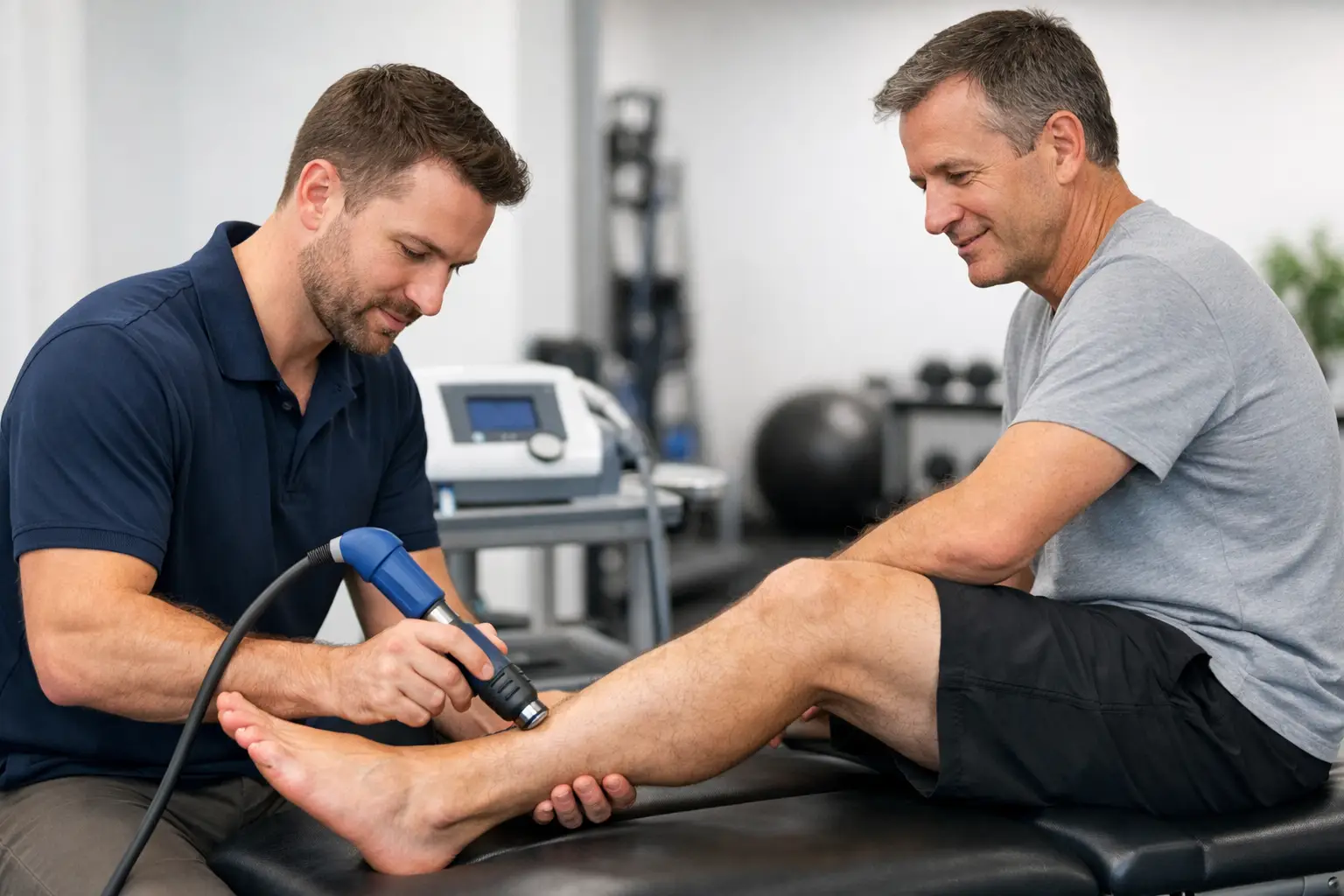
A search for “shockwave therapy review Hamilton” often starts with a frustratingly familiar problem: Achilles pain that has lingered through rest, stretching, new shoes, massage, and attempts to simply push through it. You may feel it on the first few steps in the morning, during a run, when climbing stairs, or after a leg workout. The question is not only whether shockwave therapy can help. It is whether it makes sense for your Achilles problem and what needs to happen alongside it.
Shockwave therapy can be a useful part of a plan for some persistent Achilles tendon problems. It is not a standalone fix, and a good review should not present it as one. The best outcomes usually come from a clear diagnosis, sensible activity modification, progressive tendon loading, and hands-on treatment when it helps you move and train more effectively.
What Achilles tendinopathy actually is
Achilles tendinopathy is persistent pain and reduced load tolerance in the Achilles tendon, which connects the calf muscles to the heel. It commonly develops when the tendon is repeatedly asked to handle more force than it currently tolerates. That can happen after suddenly increasing running distance, hill work, sprinting, court sports, jumping, or heavy calf training. It can also build gradually when training volume has not changed much but recovery, footwear, work demands, or overall activity have.
There are two common presentations. Mid-portion Achilles tendinopathy causes pain and thickening a few centimetres above the heel bone. Insertional Achilles tendinopathy causes pain where the tendon attaches directly to the back of the heel. This distinction matters because the exercises, range of motion, and use of certain treatments may need to change.
Tendon pain is not always proportional to tissue damage. A tendon can be sore, stiff, and reactive without being torn. At the same time, not every pain at the back of the ankle is Achilles tendinopathy. Bursitis, a calf strain, ankle joint irritation, a partial tear, or other conditions can create similar symptoms. That is why an assessment comes before choosing a treatment tool.
Common signs of Achilles tendon pain
Achilles tendinopathy often shows up as pain that settles after warming up, then returns later in the day or the morning after activity. Stiffness after sitting, discomfort on hills or stairs, and a tender spot in the tendon are also common. Some people notice swelling or thickening; others mainly notice that their usual run, lift, or walk now feels unreliable.
A useful clue is the tendon’s response over the next 24 hours. Mild discomfort during activity can sometimes be manageable, especially if it returns to baseline by the next morning. A clear increase in pain or stiffness that lasts into the following day is a sign that the current load may be too high.
Seek prompt medical assessment for a sudden pop, major swelling or bruising, an inability to push off or rise onto your toes, fever, unexplained redness and heat, or severe pain that is escalating rapidly. Those symptoms require more than a routine tendon treatment plan.
Why rest alone often does not solve it
Reducing aggravating activity can calm a very irritable Achilles. But prolonged rest does not rebuild capacity. Tendons adapt to progressive, appropriately dosed loading. If every painful activity is removed for weeks, the tendon and calf can become less prepared for the demands you want to return to.
The alternative is not to ignore pain and keep training exactly as before. It is to find the right starting point. For one person, that may mean temporarily reducing running hills while maintaining flat walking and controlled calf work. For another, it may mean modifying heavy lifts, court-sport sessions, or long shifts on their feet. The right plan depends on your symptoms, training history, strength, and the specific location of the tendon pain.
Shockwave therapy review Hamilton: what it can and cannot do
Shockwave therapy uses acoustic pressure waves delivered to a targeted area. In persistent tendinopathy, it may help reduce pain sensitivity and support a tendon rehabilitation plan. Research suggests it can be beneficial for some people with chronic Achilles tendinopathy, particularly when combined with a progressive exercise program.
The key phrase is combined with. Shockwave therapy does not replace calf strengthening, gradual return to running or sport, and changes to the load that initially aggravated the tendon. It also does not instantly repair a tendon. Some people notice a change in symptoms after a few sessions, while others respond slowly or not at all. Chronicity, tendon location, overall loading, sleep, medical history, and adherence to rehab all affect the result.
Treatment should feel purposeful rather than like a series of passive appointments. At Ground Up Rehab, shockwave therapy may be considered when a persistent Achilles tendon has not responded adequately to a well-structured loading plan alone, or when pain is limiting the ability to progress that plan. It is one option within a broader rehabilitation strategy, not the strategy itself.
Shockwave is not appropriate for everyone. Your clinician should review relevant medical history, medications, sensory changes, circulation concerns, and the possibility of a different diagnosis before recommending it. If insertional pain is present, the plan must also account for compression at the heel attachment. Simply applying the same protocol used for mid-portion tendon pain is not good clinical reasoning.
How an Achilles assessment should guide treatment
A useful assessment does more than identify a sore spot. It looks at where the pain is located, what activities provoke it, how the tendon responds the next day, and whether you can perform repeated calf raises with control. It also examines ankle movement, calf strength and endurance, balance, running or walking mechanics when relevant, training changes, footwear, and the demands of your job or sport.
For a Hamilton runner, this might include the effect of escarpment hills, a recent race build, or a sudden return to outdoor running. For a tradesperson, it may be long periods standing on concrete, climbing ladders, or repeated stair use. For a gym-goer, the trigger may be a rapid increase in plyometrics, loaded calf work, or high-volume lower-body training.
The goal is not to blame one movement pattern or declare that a joint is out of place. It is to identify the factors that are keeping the tendon overloaded or preventing it from rebuilding capacity.
Building the tendon back up
Progressive loading is the centre of Achilles tendinopathy rehabilitation. Early on, isometric calf exercises can be useful for some people when the tendon is particularly painful. From there, rehabilitation typically progresses to slow, controlled calf raises and heavier strengthening through ranges that the tendon can tolerate.
As strength and symptoms improve, the program should become more specific. Runners may need a staged return to faster running, hills, and volume. Court-sport athletes may need hopping, landing, acceleration, and deceleration drills. People whose work is physically demanding need capacity for the tasks they cannot avoid.
This process is rarely perfectly linear. A flare-up does not automatically mean you have caused new damage or failed rehab. It may mean the last progression was too large, recovery was lower than usual, or total activity rose without being accounted for. The plan should be adjusted, not abandoned.
Hands-on treatment may also have a role when it helps reduce discomfort or improves movement enough to train more effectively. Depending on the presentation, this may include deep soft tissue work, instrument-assisted soft tissue therapy, joint mobilization, or Class IV laser therapy. These treatments should support the active part of care, not distract from it.
What to expect from a credible shockwave therapy plan
A credible plan starts with a diagnosis and clear goals. You should understand why shockwave therapy is being suggested, what changes would count as progress, and what loading work you are expected to complete between visits. Your clinician should also explain that temporary soreness after treatment can occur and help you manage activity accordingly.
Be cautious with any shockwave therapy review in Hamilton that promises to eliminate Achilles pain in a fixed number of visits. Tendon problems differ too much for that kind of guarantee. A better standard is measurable improvement: less morning stiffness, better calf-raise endurance, more tolerance for walking or training, and a gradual return to the activities that matter to you.
If Achilles pain is limiting your runs, lifts, workdays, or weekend activity, it is worth having it assessed rather than cycling between rest and repeated flare-ups. A focused plan can help you understand what your tendon currently tolerates and build it back toward what you need it to do. Book an assessment with Ground Up Rehab if this sounds like the pain you are dealing with.
