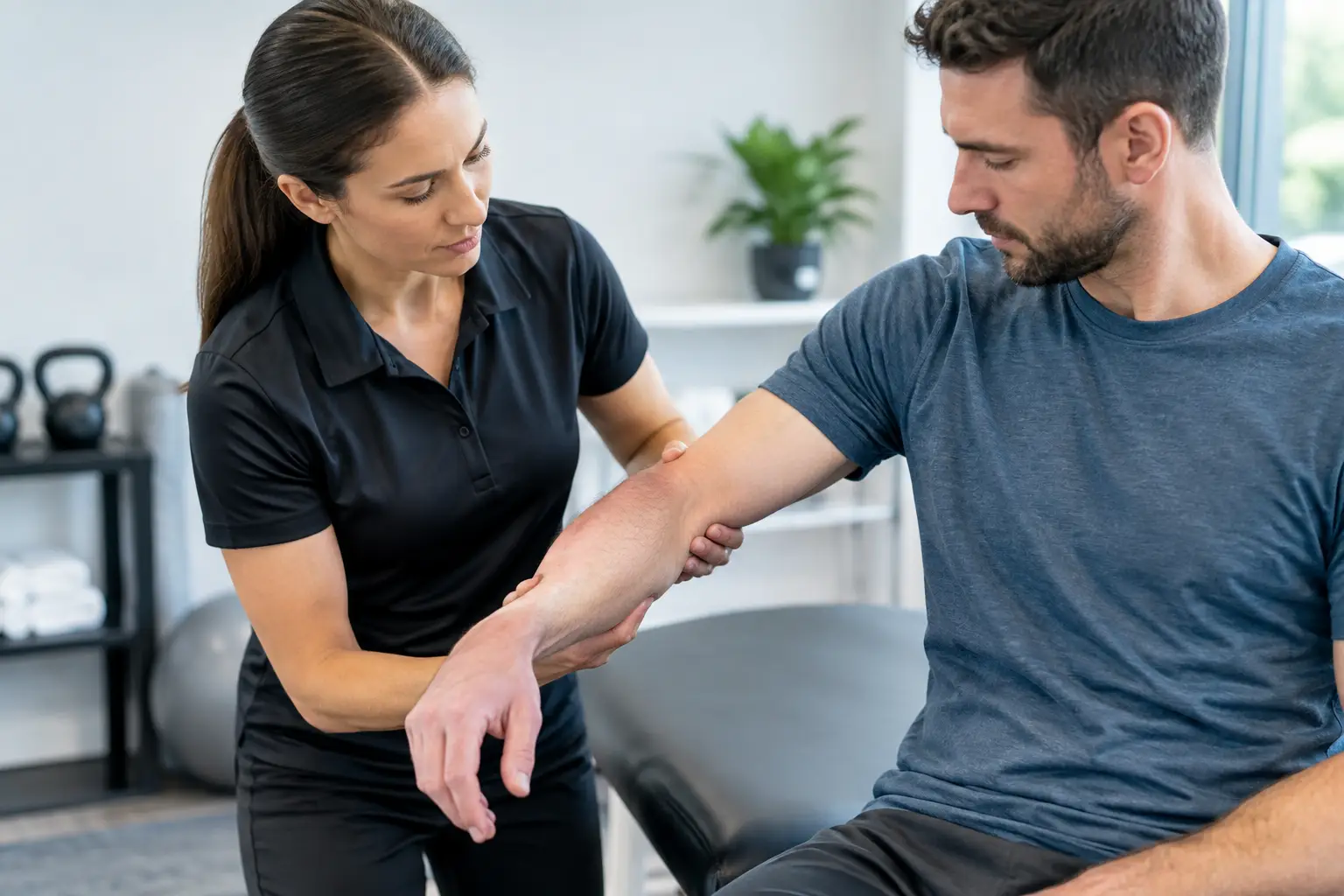
A painful inner elbow can turn ordinary tasks into a constant reminder that something is not right. Golfer's elbow symptoms often show up when you grip a barbell, shake hands, carry groceries, use tools, type for long periods, or pick up a child. Despite the name, this problem is not limited to golfers. It is common in active adults, tradespeople, desk workers, racquet-sport athletes, and anyone whose forearm is repeatedly asked to grip, pull, twist, or stabilize.
What is golfer's elbow?
Golfer's elbow is the common name for medial elbow tendinopathy, sometimes called medial epicondylalgia. It involves pain around the bony bump on the inside of the elbow, known as the medial epicondyle. Several forearm muscles that bend the wrist and fingers, and turn the palm downward, attach in this area through a shared tendon.
When that tendon is exposed to more load than it can currently tolerate, it can become painful and sensitive. This does not necessarily mean the tendon is torn or permanently damaged. Tendon pain is often more complex than a simple injury picture. It can be influenced by recent training changes, repetitive work demands, recovery, grip capacity, shoulder and wrist function, and how much load the tissue has been handling over time.
The label matters less than understanding what is provoking the pain and what your elbow needs to build capacity again. An accurate assessment also helps distinguish medial elbow tendon pain from other conditions that can feel similar.
Common golfer's elbow symptoms
The most recognizable symptom is aching, sharp, or burning pain on the inner side of the elbow. It may be very localized to the bony attachment, or it may spread down the inner forearm toward the wrist. Some people notice it only during activity. Others feel it after a busy workday, a heavy lifting session, or the morning after a demanding round of golf.
Symptoms commonly appear with gripping, wrist flexion, twisting a jar lid, carrying a suitcase, rowing, pull-ups, deadlifts, curls, and using hand tools. You may notice that your grip feels weaker, not always because the muscles have lost strength, but because pain makes the nervous system less willing to produce force.
Other common experiences include tenderness when pressing the inside of the elbow, discomfort when fully straightening the arm, and pain during resisted wrist or finger movements. A golfer may feel it through impact or on follow-through. A lifter may notice it at the bottom of a pull-up, while holding a heavy dumbbell, or during high-volume curls. A tradesperson may notice it after repetitive screwdriving, hammering, or prolonged tool use.
Symptoms can fluctuate. The elbow may feel manageable while you are warmed up, then ache later that evening. Alternatively, it may hurt immediately with gripping but settle quickly once the task stops. That pattern can offer useful clues, but it does not confirm a diagnosis on its own.
Symptoms that may point to something else
Inner elbow pain is not always golfer's elbow. Numbness, tingling, or electric sensations into the ring and little fingers may suggest irritation of the ulnar nerve, which travels behind the inside of the elbow. Pain after a clear traumatic event, major swelling, bruising, a sense of instability, or a sudden loss of strength may require a different assessment.
Pain higher in the arm, neck symptoms, or symptoms that travel well beyond the elbow can also change the clinical picture. This is why an assessment should look beyond the sore spot rather than relying only on a self-diagnosis from the location of pain.
Why does golfer's elbow develop?
Most cases develop gradually when load increases faster than tendon capacity. That increase can be obvious, such as starting a new job, adding more pull-ups, returning to golf after winter, or dramatically increasing lifting volume. It can also be less obvious. A busy period at work combined with regular gym training and less recovery can be enough to push a previously manageable elbow over its threshold.
Technique and equipment can contribute, but they are rarely the whole story. A golfer may benefit from reviewing grip mechanics or club setup, yet their elbow also needs enough forearm, wrist, shoulder, and trunk capacity to tolerate repeated swings. The same principle applies to lifting. Changing wrist position on a curl may reduce irritation, but a long-term plan usually involves rebuilding tolerance to gripping and loading rather than avoiding those demands forever.
Previous elbow, wrist, shoulder, or neck issues may play a role too. If one area is restricted or painful, another area may take on more work. That does not mean the body is misaligned or broken. It means the full movement and loading picture deserves attention.
What tends to aggravate inner elbow pain?
Repeated gripping is usually the biggest irritant. High-rep pulling exercises, loaded carries, heavy deadlifts, bar hangs, climbing, racquet sports, and manual work can all aggravate symptoms. Some people also react to sustained wrist flexion, such as holding a phone, driving, or working at a keyboard with the wrist held in an awkward position.
Complete rest may calm pain temporarily, but it is not always the best long-term answer. Tendons generally need appropriately dosed load to regain capacity. The right approach depends on irritability. If every grip is sharply painful, training through it aggressively is unlikely to help. If symptoms are mild and settle quickly, a modified training plan may allow you to stay active while rebuilding tolerance.
When should you have golfer's elbow assessed?
Consider an assessment if pain has persisted for more than a couple of weeks, keeps returning when you resume training, affects work or sleep, or is making you avoid normal activities. It is also worth getting checked when you are unsure whether the issue is tendon-related, nerve-related, or coming from somewhere else.
Seek timely medical assessment for severe swelling, deformity after an injury, fever or redness around the joint, rapidly worsening weakness, or persistent numbness and tingling in the hand. These findings do not automatically mean something serious is happening, but they should not be managed by guessing at home.
How inner elbow pain is assessed
A useful assessment starts with the story. When did symptoms begin? What changed in training, work, golf, or daily life? Which grips, positions, and tasks reproduce it? What happens during activity, later that day, and the next morning?
Physical testing may include palpating the tender area, checking wrist and finger strength, assessing grip tolerance, and using resisted movements to see which tissues are sensitive. The elbow is assessed alongside the wrist, shoulder, neck, and upper back when relevant. For active people, it is also useful to look at the specific task that matters most, whether that is a golf swing, barbell work, manual labour, or carrying a toddler.
Imaging is not required for every sore elbow. It may be considered when the history or examination suggests a more significant injury, when progress has stalled, or when another diagnosis needs to be ruled out.
Treatment and rehabilitation for golfer's elbow symptoms
The goal is not simply to make the elbow feel better for a day. It is to reduce unnecessary irritation, restore useful movement, and progressively build the tendon and surrounding muscles back to the demands of your life.
Early treatment may include adjusting painful activities rather than stopping everything. That could mean reducing gripping volume, changing bar selection, using straps temporarily for selected lifts, shortening a range of motion, or spacing out high-demand work and training days. These are short-term load-management tools, not permanent restrictions.
Hands-on treatment can be useful when it helps settle pain, improve short-term movement tolerance, or lets you begin rehabilitation more effectively. Depending on the assessment, this may include deep soft tissue work, joint treatment, or instrument-assisted soft tissue therapy such as Graston. Shockwave therapy or Class IV laser therapy may also be considered for some persistent tendon presentations. None of these are standalone cures. They work best as part of a plan that includes progressive loading and clear activity modification.
Progressive loading builds capacity
Rehabilitation typically begins with exercises that load the forearm at a tolerable level, then progresses toward the grips and tasks that caused trouble in the first place. This may include wrist and finger strengthening, controlled forearm rotation, grip work, and gradually heavier pulling, carrying, or sport-specific drills.
The correct exercise is only half the equation. Dose matters. Too little load may not build capacity; too much too soon can keep the elbow reactive. Symptoms during exercise are not always a reason to stop, but pain should be monitored alongside how the elbow feels later that day and the following morning. A good plan adapts as your response changes.
At Ground Up Rehab in Hamilton, the focus is on identifying the drivers of your elbow pain, using meaningful hands-on care where it fits, and building a progressive plan that gets you back to work, training, golf, and everyday gripping with more confidence.
If these golfer's elbow symptoms sound familiar, book an assessment rather than waiting for another flare-up to force your hand. A clear diagnosis and a progressive plan can help you move from protecting the elbow to trusting it again.
