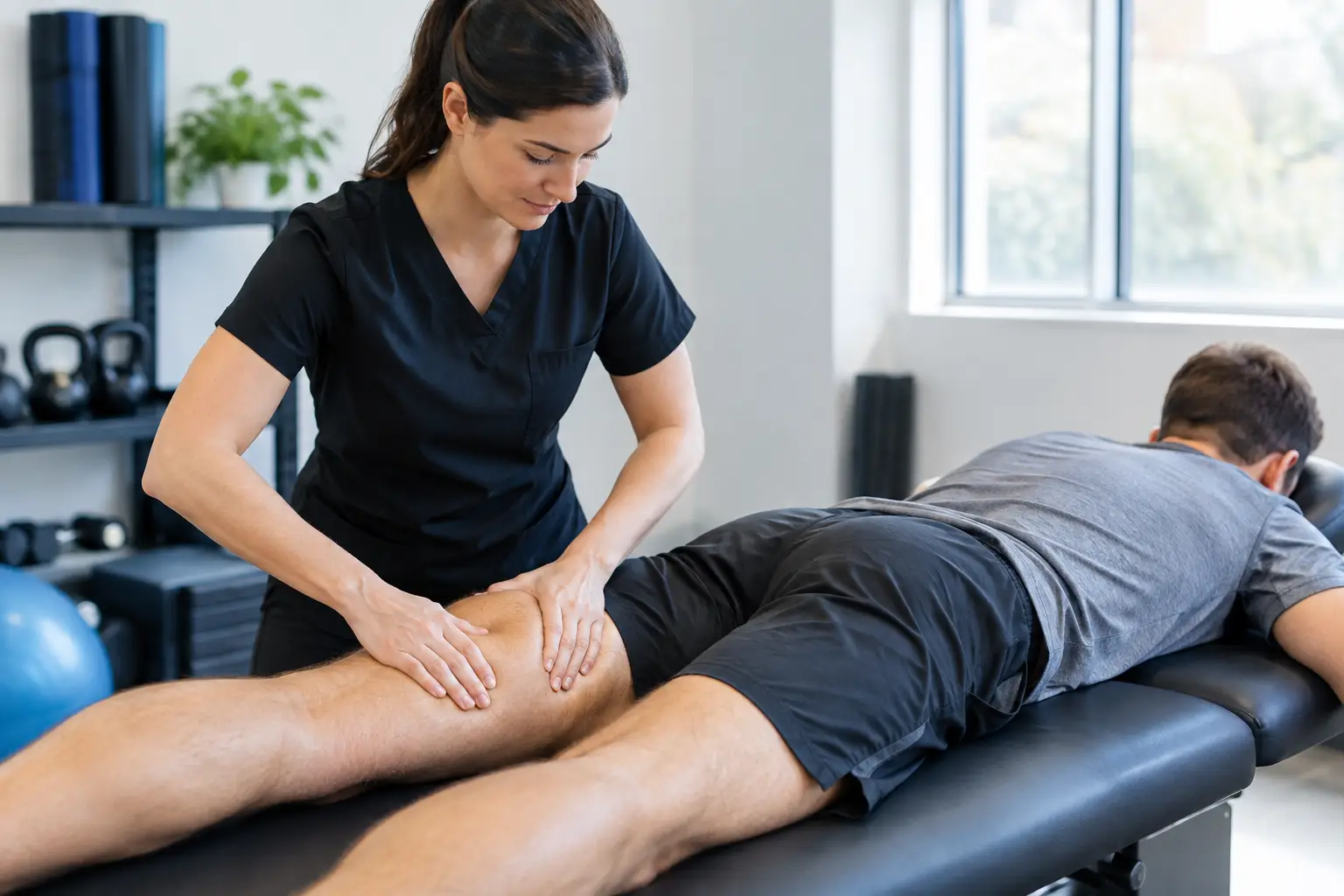
A hard lower-body session can make walking downstairs feel like a negotiation. That leads many active adults to ask, does massage reduce muscle soreness or is it simply a short-lived way to feel better? Massage can help some people feel less sore and less stiff after training, but it is not a shortcut around recovery, and it cannot tell you whether post-workout pain is normal soreness or an injury that needs attention.
For most people, the useful question is not whether massage is good or bad. It is whether the symptoms fit delayed onset muscle soreness, whether the treatment helps you move more comfortably, and what needs to happen next to return to training without repeating the same flare-up.
What post-workout muscle soreness usually means
Delayed onset muscle soreness, often called DOMS, is the tenderness, stiffness, and temporary loss of comfort that develops several hours after unfamiliar or demanding exercise. It commonly peaks one to three days later. A new running program, a heavy squat session, hill repeats, a long hike, or returning to the gym after time away can all trigger it.
DOMS is especially common after exercises that involve a strong lowering phase, such as lowering into a squat, descending stairs, landing from jumps, or lowering a weight under control. The muscle has been exposed to a load it was not recently prepared to handle. That does not automatically mean damage has been done in a serious sense. It usually means the tissue and nervous system are adapting to a new training demand.
The sensation can be frustrating, but normal DOMS tends to be broad and diffuse through the worked muscle. Both quadriceps may ache after a leg workout, for example. It generally improves day by day, even if the first 48 hours are uncomfortable.
Does massage reduce muscle soreness? Yes, with limits
Massage may reduce the feeling of soreness and stiffness for some people after demanding exercise. Hands-on work can be calming, may temporarily improve comfort with movement, and can make it easier to tolerate light activity while symptoms settle. For someone who is generally sore after an unusual training load, that can be worthwhile.
The trade-off is that massage does not erase the reason you became sore. It does not instantly restore full strength, make a muscle ready for another maximal session, or replace a gradual progression in training volume and intensity. Feeling looser after a massage is not the same as being fully recovered.
Research on massage and DOMS generally supports a modest short-term improvement in perceived soreness. Results are less convincing when the goal is dramatically accelerating muscle repair or restoring performance immediately. That distinction matters for runners, lifters, and recreational athletes who are tempted to treat reduced soreness as permission to push through another hard session.
A practical approach is to use massage as one tool for symptom relief, then let your response guide the next workout. If you can move more normally, symptoms are clearly settling, and the planned activity is adjusted appropriately, massage may support recovery. If the same issue returns after every session, the real solution is usually found in training load, movement tolerance, strength capacity, technique, or a problem that was never simple DOMS in the first place.
When soreness may be more than DOMS
Not every ache after training is routine muscle soreness. A strain, tendon irritation, joint-related pain, or referred pain can all be mistaken for tight muscles, particularly when you are trying to stay active through a busy work or training schedule.
Muscle soreness deserves an assessment when pain is sharp, pinpointed, or one-sided; when it started with a pop, sudden pull, fall, or awkward lift; or when bruising, visible swelling, marked weakness, or loss of function is present. Pain that worsens rather than improves over several days also deserves attention.
The same is true if symptoms are affecting sleep, walking, climbing stairs, gripping, sitting, or basic work tasks. A runner with a focal calf pain after speed work, for example, may have a calf strain rather than ordinary soreness. A lifter with persistent pain at the front of the knee after squatting may be dealing with patellofemoral pain or patellar tendon irritation. Massage may feel good around these problems, but it should not become the only plan.
Seek urgent medical care for severe swelling, a limb that is hot or discoloured, chest pain, shortness of breath, numbness that is progressing, fever, or unusually dark urine after intense exertion. These symptoms are not typical DOMS.
Why recurring soreness happens
Recurring soreness is often a capacity-versus-demand issue. You may be doing more than your current training base can absorb, even if the workout looks reasonable on paper. A sudden jump in running mileage, adding high-rep leg work after months away, increasing weight and volume in the same week, or returning to sport after an injury can all overwhelm a previously manageable baseline.
Recovery habits and life stress can influence how hard training feels, but the training plan still matters most. If every workout leaves you excessively sore for days, the answer is not necessarily more aggressive soft tissue work. It may be fewer hard sets, more time between demanding sessions, a better warm-up strategy for the specific activity, or a slower loading progression.
Sometimes soreness is concentrated around an area that already had a problem. A shoulder that repeatedly feels “worked” after pressing, an Achilles that is stiff every morning, or a low back that flares after deadlifts may be signalling an underlying pain presentation rather than ordinary post-exercise fatigue. That is where a proper assessment is more useful than guessing.
How treatment fits into a better recovery plan
At Ground Up Rehab, assessment starts by clarifying what you are actually experiencing. We look at where symptoms are felt, what triggered them, how they behave over the following days, your relevant training history, and what movements are currently limited. We also assess strength, mobility where relevant, and your ability to tolerate the tasks that matter to you.
If symptoms are consistent with uncomplicated DOMS, the conversation may focus on modifying the next few training sessions rather than stopping movement completely. Light, comfortable activity can be preferable to doing nothing, but it should not be used to force painful tissue through an aggressive workout. The aim is to keep you moving while allowing the response to settle.
When there is an identifiable injury or recurring flare-up, hands-on treatment may be used to reduce symptoms and help you move with less restriction. Depending on the presentation, this can include deep soft tissue therapy, joint mobilization, Graston or instrument-assisted soft tissue therapy, cupping, or other targeted options. These treatments are not framed as a cure or a way to break up tissue. They are tools that may make it easier to begin the work that creates lasting change.
That work is progressive rehabilitation. A calf strain needs a carefully progressed return to calf loading, running, and change of direction. Persistent knee pain may require adjustments to squat or running volume alongside progressive quadriceps and hip strengthening. Shoulder pain with lifting may need a plan that rebuilds pressing tolerance instead of repeated short-term relief between workouts.
Massage is most useful when it supports the next step
There is nothing wrong with choosing massage after a challenging workout if it helps you feel better and you enjoy it. Just keep the expectation realistic. It can be part of recovery, particularly when soreness is widespread and improving, but it should not be your only strategy for recurring pain or repeated training setbacks.
A better long-term marker is whether you are gradually able to tolerate more of the activities you value: a full workday without flare-ups, a comfortable run, heavier training, a round of golf, or playing with your kids without paying for it for days afterward. That requires matching load to capacity and addressing the specific issue when pain does not behave like normal soreness.
If your muscle soreness is unusually intense, keeps returning in the same area, or is stopping you from training, working, or moving normally, book an assessment with Ground Up Rehab in Hamilton. A clear diagnosis and a progressive plan can help you move beyond temporary relief and return to activity with more confidence.
