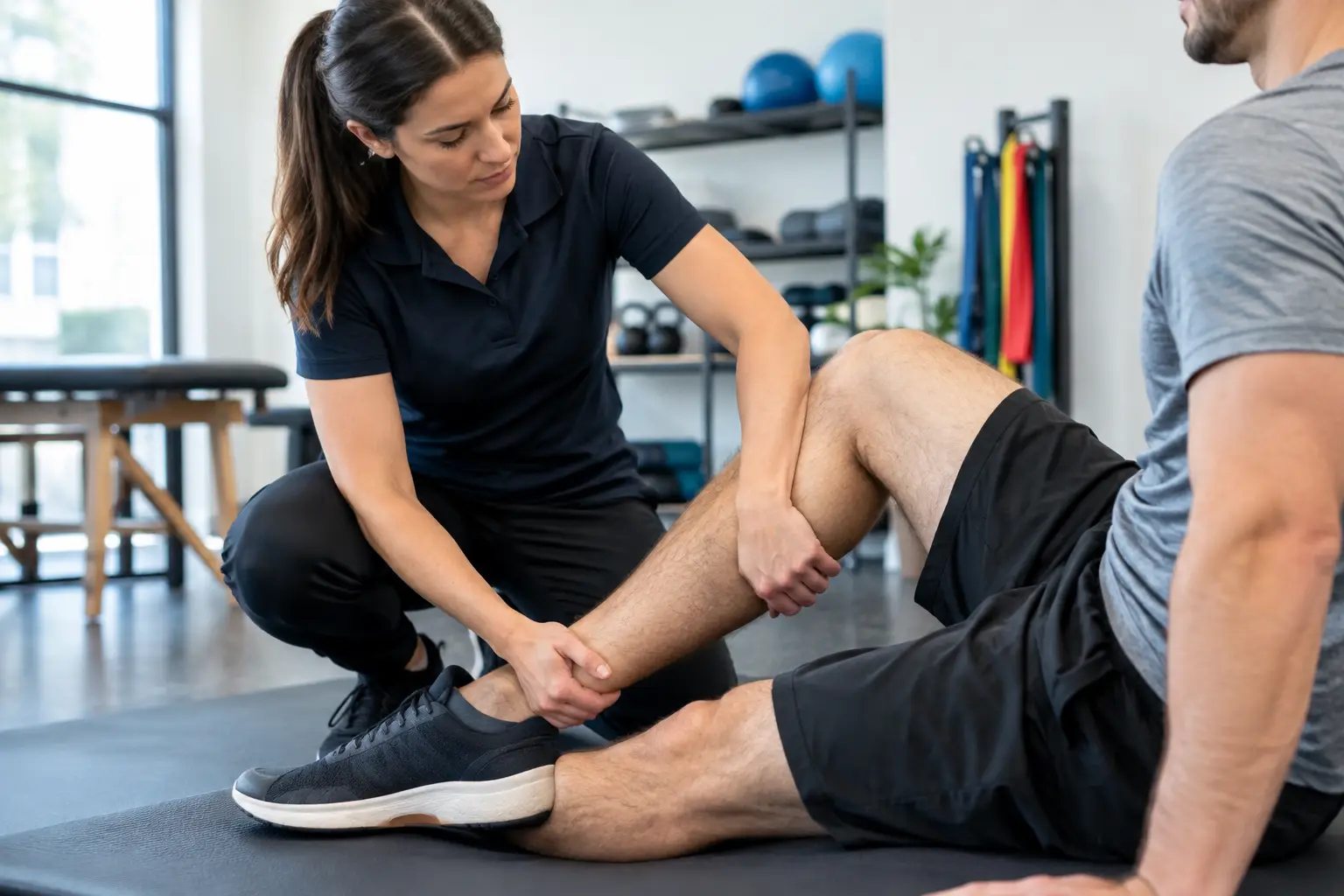
A calf muscle strain can feel like a sudden snap during a sprint, a sharp pull when pushing off a curb, or a lingering tight spot that makes every run feel uncertain. It is a common injury in runners, court-sport athletes, gym-goers, and adults whose work keeps them on their feet. It can also happen during an ordinary walk when the calf has been doing more than it is prepared for.
The mistake is treating every calf injury as simple tightness. Some strains settle quickly with sensible load changes. Others recur because the muscle is no longer painful at rest but has not rebuilt the strength, endurance, or speed capacity needed for running, lifting, work, or sport.
What is a calf muscle strain?
The calf is made up primarily of the gastrocnemius and soleus muscles. Both connect to the Achilles tendon and help point the foot down during walking, stair climbing, jumping, running, and pushing a sled or loaded cart. The gastrocnemius crosses both the knee and ankle, while the deeper soleus works hard when the knee is bent and during longer periods of standing or running.
A strain occurs when muscle fibres or the tissue where the muscle meets its tendon are overloaded beyond what they can currently tolerate. This can range from a mild injury with local soreness and little loss of function to a more substantial tear with bruising, swelling, weakness, and difficulty walking.
People often describe a gastrocnemius strain as feeling like they have been kicked in the back of the leg. A soleus strain can be less dramatic, often presenting as a deeper ache or tightness that builds through a run or after a long day on the job. Symptoms alone cannot confirm the exact structure involved, which is why a proper assessment matters when pain is significant, recurring, or limiting activity.
Common calf strain symptoms
A calf strain usually causes pain in the back of the lower leg, often in one distinct area. The pain may be sharp at the moment of injury and become stiff or sore afterward. Walking quickly, climbing stairs, rising onto the toes, running, and jumping are common aggravators.
Other signs can include swelling, bruising that appears over the next day or two, tenderness when pressing the muscle, cramping, and reduced confidence pushing off the affected foot. More significant strains may make it difficult to perform a single-leg calf raise or walk without a limp.
A calf that feels tight is not automatically strained. Tightness can also come from training fatigue, delayed-onset muscle soreness, Achilles tendon irritation, nerve-related symptoms, or a change in walking mechanics after another injury. The right plan depends on what is actually driving the problem.
Why calf strains happen
Most calf strains are not caused by one bad movement in isolation. They happen when the demand placed on the calf rises faster than its current capacity. A fast sprint after weeks of easy jogging, a return to pickup basketball, hill running, or adding more lower-body volume in the gym can all expose a gap in capacity.
The calf also takes substantial load during everyday life. Tradespeople walking on uneven ground, healthcare workers on long shifts, and parents carrying a child up stairs may notice symptoms even if they do not identify as athletes. A prior ankle injury, reduced ankle motion, limited calf strength, poor tolerance for repeated hopping, or a recent jump in activity can all contribute.
Age can be a factor as well. Calf strains are more common in adults returning to high-speed activity after time away, particularly when enthusiasm exceeds preparation. That does not mean you need to avoid sport or train cautiously forever. It means the return needs to build from the demands you can handle now toward the demands you want to meet.
When a calf injury needs assessment
A mild calf strain may improve steadily over several days. Assessment is a good idea if pain is sharp, you heard or felt a pop, there is bruising or notable swelling, you cannot walk normally, or symptoms are not improving as expected. It is especially worthwhile if the same calf keeps tightening or straining whenever you increase running, lifting, or court sports.
Some calf symptoms need urgent medical attention rather than routine rehabilitation. Seek prompt care for sudden one-sided calf swelling, warmth, redness, unexplained severe pain, shortness of breath, chest pain, fever, or symptoms after a long period of immobility. These can be signs of conditions that should not be managed as a typical muscle injury.
A complete Achilles rupture can also be mistaken for a calf strain. A sudden pop, major weakness pushing off, and an inability to rise onto the toes warrant timely medical assessment.
How a calf muscle strain is assessed
A useful assessment goes beyond finding the sore spot. It begins with how the injury happened, what activities provoke it, how symptoms have changed, and what you need to return to. A runner preparing for a 10K has different calf demands than a warehouse worker, recreational tennis player, or powerlifter.
The physical exam may assess walking, ankle motion, calf tenderness, swelling, resisted muscle testing, single-leg calf raises, balance, squat and lunge patterns, and eventually hopping or running tolerance. The goal is not simply to label the tissue. It is to understand the severity of the injury, rule out concerns requiring medical referral, and identify why the calf may have been overloaded.
Imaging is not necessary for every calf strain. It may be considered when the injury is severe, the diagnosis is unclear, progress is slower than expected, or another condition is suspected.
Treatment in the early phase
In the first few days, the priority is to settle irritability without completely shutting the leg down. Relative rest can mean temporarily reducing running, jumping, hard hill walking, or heavy lower-body training while maintaining comfortable movement. A limp is usually a sign that the activity is currently too demanding.
Gentle ankle movement and carefully selected loading can often begin earlier than people expect, provided it does not create a meaningful pain increase during activity or a worse response the next day. Aggressive stretching into sharp pain is rarely helpful in the early phase. The muscle needs time and appropriately dosed load, not a contest to regain range immediately.
Hands-on treatment can be useful when it helps reduce sensitivity, improve comfortable movement, or lets someone progress their rehabilitation more effectively. Depending on the presentation, this may include deep soft tissue work, instrument-assisted soft tissue therapy, cupping, or joint treatment to address contributing ankle or foot restrictions. These are tools, not standalone fixes. They work best alongside a clear loading plan.
Rehabilitation: rebuilding calf capacity
The most reliable way back from a calf strain is progressive loading. That starts with the level the tissue can tolerate and advances as symptoms, strength, and function improve. Early exercises may involve isometric calf holds and controlled double-leg calf raises. From there, the focus shifts toward single-leg strength, endurance, and work with both a straight knee and bent knee to challenge the gastrocnemius and soleus differently.
As strength improves, rehabilitation should match the activity you are returning to. A runner may need gradual exposure to faster running, hills, and repeated push-off. A basketball player needs hopping, landing, acceleration, and deceleration. Someone returning to physically demanding work may need repeated step-ups, carries, stairs, and time-on-feet tolerance.
The exact timeline varies. A minor strain may settle in a few weeks, while a more substantial injury can take longer. Pain disappearing is encouraging, but it is not the only return-to-sport marker. You should also be able to handle relevant strength and endurance tests, tolerate progressive impact, and complete practice or work demands without a significant symptom flare the following day.
How Ground Up Rehab approaches calf strains
At Ground Up Rehab in Hamilton, a calf strain is approached as both an injury and a capacity problem. The assessment looks at the immediate painful area, but also at ankle mobility, calf strength, training changes, running or lifting demands, and the movements that keep bringing symptoms back.
Treatment may combine meaningful hands-on care with exercise rehabilitation and progressive loading. If appropriate, options such as Class IV laser therapy or shockwave therapy may be considered as part of a broader plan, particularly when symptoms have become persistent. The aim is not to chase temporary relief. It is to restore the calf's ability to tolerate the specific forces required for your work, training, and sport.
If your calf pain feels like more than ordinary post-workout soreness, or it keeps returning when you try to get active again, book an assessment. A clear plan can help you move from protecting the calf to trusting it again.
