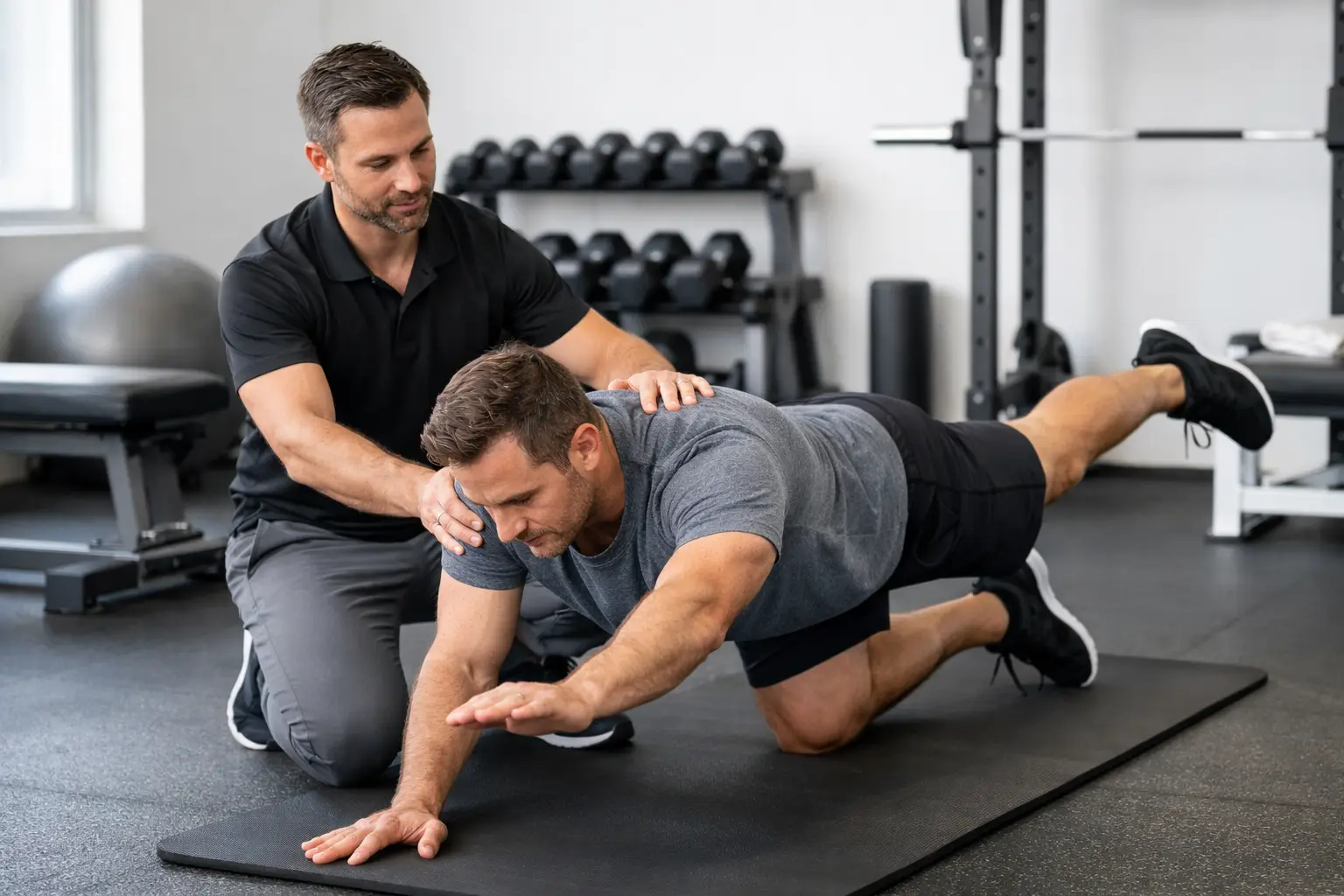
Low back pain that shows up before, during, or after lifting changes how you train. You may spend 20 minutes stretching, use a massage gun, perform endless activation drills, and still feel a sharp catch on deadlifts or a familiar ache after squats. If you are searching for the best warm up for pain free lifting, the more useful question is often: why does your back need such a long warm-up to tolerate a load in the first place?
For many lifters, a warm-up can reduce stiffness and improve confidence. It cannot reliably solve recurring low back pain caused by an irritated structure, poor load tolerance, an abrupt jump in training volume, or a movement strategy your body currently does not tolerate well. The goal is not to avoid every sensation. It is to understand the problem, build capacity, and return to lifting with a plan.
Low back pain during lifting is not one diagnosis
“Low back pain” describes a symptom, not a single injury. Pain may come from sensitive muscles, joints, discs, connective tissues, or referred symptoms from nearby structures. In many cases, it is not possible or necessary to identify one exact tissue immediately. What matters is the pattern: where symptoms occur, what movements provoke them, how long they last, and how your back responds over the next 24 to 48 hours.
Some people feel pain at the bottom of a squat. Others are fine during training but stiffen up after deadlifts, rows, carries, or a long shift at work. Pain may stay local to the low back, refer into the buttock, or travel down the leg. Leg symptoms, numbness, tingling, or noticeable weakness deserve closer assessment because they can indicate nerve involvement.
A good rehabilitation plan starts by separating normal training effort from a pain pattern that is limiting your progress.
Why your back may hurt when you lift
Low back flare-ups are rarely explained by one “bad” rep. More often, the issue is a mismatch between what your back can currently tolerate and what you are asking it to do.
A sudden increase in load, sets, training days, or exercise variation is a common trigger. So is returning to the gym after time off and trying to resume previous numbers too quickly. Poor sleep, high work stress, long periods of sitting, and fatigue can also lower your tolerance temporarily. That does not mean lifting is dangerous. It means your programming may need to account for the capacity you have right now.
Technique can matter, but it is not as simple as finding one perfect spinal position. A rounded back is not automatically harmful, and a neutral spine is not a guarantee against pain. The more practical question is whether you can control and repeat a movement under the load and range you are using without symptoms escalating during or after training.
Symptoms that warrant an assessment
A mild, short-lived ache after an unfamiliar training session may settle with sensible load adjustment. Recurring pain, pain that stops you from training, or symptoms that keep returning every time you deadlift or squat are worth assessing.
Book an assessment if your pain persists beyond a couple of weeks, repeatedly flares with lifting, spreads into the buttock or leg, or makes normal tasks like getting out of a chair, driving, working, or sleeping difficult. Seek prompt medical attention for new bowel or bladder changes, numbness around the groin or saddle area, rapidly worsening leg weakness, fever, unexplained weight loss, significant trauma, or severe unrelenting pain.
The best warm up for pain-free lifting depends on your pattern
The best warm-up is not a universal sequence of foam rolling, band work, and stretches. It should prepare you for the lift you are about to perform while respecting your current symptoms.
For a lifter with low back pain, that often starts with a brief general warm-up to raise body temperature, followed by movement practice and gradual exposure to the specific lift. Five to 10 minutes of easy cycling, walking, or rowing may help reduce stiffness. From there, a small number of targeted movements can be useful if they improve your range, control, or confidence without aggravating symptoms.
For example, someone whose back is sensitive to bending may benefit from practising a controlled hip hinge at a comfortable range before deadlifting. Someone irritated by extension or prolonged standing may respond better to a different setup, such as a slightly elevated pull, a reduced range, or a temporary change in exercise selection. The point is not to chase fatigue before training. It is to rehearse the task and build up to working sets gradually.
Your ramp-up sets are part of the warm-up. Instead of jumping from an empty bar to a challenging load, use several controlled sets that increase load while you monitor symptoms and movement quality. This gives your body information: is today a day to proceed, modify, or switch the session?
What to avoid when warming up a painful back
Do not treat the warm-up as a test you must pass by forcing painful ranges. Aggressively stretching into pain, repeatedly cracking your back, or adding more and more drills because you do not trust your body can leave you more guarded, not less.
Avoid using temporary symptom relief as proof that you are ready for any load. Heat, manual therapy, or a good warm-up may make movement feel easier, which can be useful. But if you repeatedly return straight to the same load, volume, and technique that triggered symptoms, the flare-up often returns.
A better approach is to use symptom response to guide training. Mild discomfort that stays manageable, does not progressively worsen, and settles back to baseline by the next day may be acceptable in rehabilitation. Sharp pain, spreading symptoms, increasing pain set to set, or a significant next-day flare suggests the exercise, range, load, or volume needs adjustment.
Assessment should guide the plan, not just the treatment
At Ground Up Rehab, assessment for lifting-related low back pain looks beyond where it hurts. We assess your symptom history, training exposure, work demands, sleep, previous injuries, range of motion, strength, and the specific lifts that matter to you. When appropriate, we look at your squat, hinge, pull, press, or carry rather than relying only on a treatment table exam.
That information helps determine whether your first step is reducing load, changing range, modifying exercise selection, rebuilding trunk and hip strength, or gradually reintroducing a movement you have been avoiding. A person with pain during a barbell deadlift may temporarily tolerate trap-bar pulls, block pulls, split squats, or machine-based training better. Another person may be ready to keep deadlifting with a lower volume and a more deliberate progression. It depends on the presentation.
Hands-on care can be useful when pain, stiffness, or muscle guarding is preventing productive movement. Joint treatment, deep soft tissue therapy, cupping, Graston or instrument-assisted soft tissue therapy, and Class IV laser therapy may be considered where appropriate. These are not standalone fixes. Their role is to help create a window for better movement and progressive rehabilitation.
Progressive loading is what makes lifting feel reliable again
The long-term solution for many lifting-related back pain presentations is not avoiding spinal load forever. It is rebuilding tolerance to it. Progressive loading means starting at a level you can manage and increasing one variable at a time: load, repetitions, sets, range of motion, frequency, or exercise complexity.
This process may include trunk endurance work, hip and leg strength training, controlled hinging, carries, and graded exposure to the lifts you want back. The exercises are selected for your current limitations, not because they are trendy or labelled as “back-safe.” A strong return to lifting usually comes from consistent exposure, clear progression, and enough patience to let capacity catch up.
Your back does not need a complicated ritual before every session. It needs a warm-up that fits your symptoms, training that fits your current capacity, and a plan that moves you forward instead of repeatedly resetting after flare-ups. If this sounds like your experience, book an assessment in Hamilton to identify what is driving the pattern and build a return-to-lifting plan that makes sense for you.
