Tendon pain has a way of hanging around just long enough to get frustrating. It settles into your elbow when you grip a barbell, your Achilles when you start running again, or your patellar tendon when squats and stairs suddenly feel way harder than they should. If you are looking for the best rehab tools for tendon pain, the right answer usually is not one magic device. It is a combination of tools that calm symptoms, improve loading tolerance, and help you rebuild capacity over time.
That matters because tendons do not usually respond well to the all-or-nothing approach. Complete rest can help settle an angry flare-up for a few days, but too much rest often leaves the tendon less prepared for the demands you actually care about. On the other side, pushing through sharp pain and hoping it will disappear rarely works for long. Good rehab sits in the middle. It uses the right tools at the right time, based on the tendon involved, how irritable it is, and what you need to get back to.
What makes a rehab tool useful for tendon pain?
A good tool does one of three things. It helps reduce symptoms enough that you can move better, it allows you to load the tendon in a controlled way, or it helps you progress back to sport, work, or training without guessing.
That is why the best rehab tools for tendon pain are not always the flashiest ones. A resistance band, a slant board, or a well-planned strength progression often matters more than a drawer full of gadgets. At the same time, hands-on care and treatment modalities can still be useful when they support the bigger plan rather than replace it.
The best rehab tools for tendon pain usually start simple
Isometrics and controlled loading tools
For a lot of tendon issues, one of the best starting points is a tool that helps you load the tendon without irritating it too much. That might be a heavy resistance band, a cable machine, a leg extension, a calf raise machine, dumbbells, or even just your body weight with the right setup.
Isometric exercises are often useful early on. These are holds done under tension, like a wall sit for patellar tendon pain, a calf raise hold for Achilles pain, or a wrist extension hold for elbow tendon pain. They can be a good way to introduce load with less movement, which is helpful when the tendon is sensitive. They are not a full rehab plan, but they are a strong entry point.
As symptoms settle, the most valuable tool becomes whatever lets you progressively increase load. That could mean a trap bar for heavy carries, a Smith machine for controlled heel raises, or a dumbbell for slow eccentric work. The exact equipment matters less than the ability to dose load properly.
Tempo work and pain-guided progressions
A metronome app or even a simple timer is underrated. Slow tempo reps are one of the most useful ways to make tendon loading more effective. They improve control, increase time under tension, and often help people stop rushing through rehab exercises that look easy but are doing very little.
Pain-guided loading is also important. That does not mean chasing pain, but it does mean understanding that some discomfort during tendon rehab can be acceptable. In many cases, pain during or after exercise that stays mild and settles predictably is different from a major flare-up that lingers for days. This is where assessment matters. The right progression depends on how your tendon responds, not just what exercise you saw online.
Helpful tools that support movement and symptom control
Slant boards, wedges, and range-of-motion modifications
A slant board can be a great tool for patellar tendon rehab because it changes the mechanics of a squat or decline squat and can make tendon loading more targeted. Heel wedges, elevated surfaces, and modified setup positions can also help with Achilles or hamstring tendon issues by adjusting how much range and tension you are working through.
These are useful because they let you train around the problem without completely avoiding it. If flat-ground loading is too irritable right now, a small setup change can create a tolerable entry point.
Grip tools and straps
For elbow tendon pain, small changes in grip demand can make a big difference. Fat grips, lifting straps, or even temporary modifications to handle choice can reduce irritation enough to keep you training. That does not mean avoiding grip forever. It means managing it while you build tendon capacity back up.
This is one of the biggest mistakes people make with tendon pain. They think modifying load means they are regressing. In reality, smart modification is often what keeps progress moving.
Where hands-on care and treatment modalities fit
Shockwave therapy, laser, and hands-on treatment
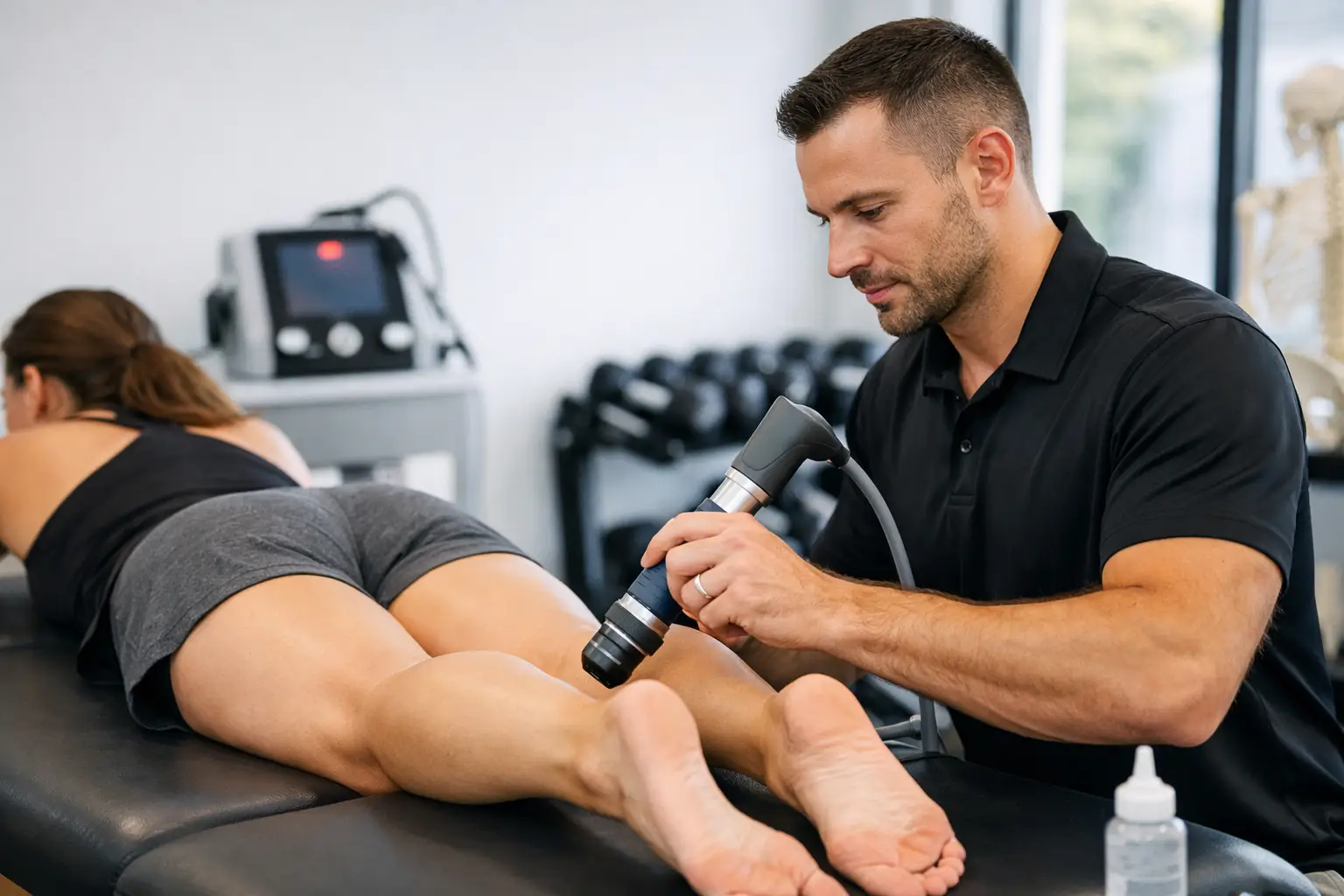
Treatment tools like shockwave therapy, Class IV laser therapy, soft tissue treatment, joint mobilization, chiropractic care, and massage therapy can all have a place in tendon rehab. The key is using them for the right reason.
If a tendon is highly irritable, these approaches may help settle symptoms, improve tolerance to movement, and make it easier to start loading again. If nearby joints are stiff or movement patterns are being limited by pain, hands-on care may help improve how you move and exercise. But these tools work best as support strategies. They are not substitutes for progressive loading.
That is a big difference between a passive care model and a rehab-focused model. If treatment helps you feel better for a day but your tendon still cannot handle stairs, running, gripping, jumping, or lifting, the job is not done. At Ground Up Chiropractic & Rehab in Hamilton, that is why tendon cases are built around assessment, symptom management, strength progressions, and return-to-performance planning rather than temporary relief alone.
Cupping and soft tissue work
Some people find cupping or soft tissue work useful when the surrounding area feels guarded, stiff, or overloaded. This can be especially helpful when tendon pain has changed how you move and now other tissues are doing too much. Again, the value is in helping you move and load better afterward. If it is only passive relief with no follow-through, results tend to stall.
The gym is one of the best rehab tools for tendon pain
This is where long-term change happens. Tendons need load, but they also need progression. A gym-based rehab plan gives you options to scale that progression with more precision than most home programs.
For Achilles tendon pain, that might mean starting with supported calf raises, then progressing to heavy standing and seated calf work, and eventually adding plyometric drills and return-to-running progressions. For patellar tendon pain, it may move from isometrics to split squats, leg press, Spanish squats, and then jump landings and sport-specific loading. For elbow pain, it could mean forearm loading, rowing variations, pull progressions, and grip exposure built back in gradually.
The gym is not valuable just because there is more equipment. It is valuable because it gives you measurable progression. More weight, more range, more speed, more confidence. Tendons respond well when loading is intentional.
What tools are overrated?
Anything that promises a quick fix usually is. Massage guns, braces, sleeves, and random mobility gadgets are not useless, but they are often over-relied on. If a tool helps you warm up, reduce sensitivity, or train with better tolerance, it may have a role. If it becomes the whole strategy, progress usually plateaus.
The same goes for generic rehab plans pulled from social media. A tool that works well for one tendon problem can be the wrong fit for another. Achilles tendon pain, gluteal tendon pain, lateral elbow pain, and proximal hamstring tendon pain all have different loading demands and different aggravating factors. The label matters less than the behaviour of the tendon and the demands of your life.
How to choose the right rehab tools for your situation
Start by asking a better question than what is the best tool. Ask what your tendon needs right now. Does it need symptoms calmed down enough to start moving? Does it need heavier strength work? Does it need better movement quality? Does it need a plan to bridge the gap between rehab exercises and full training?
That is where a proper assessment can save a lot of wasted time. If you have already tried rest, stretching, massage, random band exercises, or short appointments that did not lead anywhere, you probably do not need more guesswork. You need to know what is driving the irritation, what your current tolerance is, and how to progress without constant flare-ups.
The best rehab tools for tendon pain are the ones that fit your stage of recovery and your actual goals. For one person, that is a calf raise machine and a running progression. For another, it is a slant board, a leg press, and better squat loading. For someone else, it is a combination of shockwave, hands-on care, and progressive grip strength work that finally lets them train consistently again.
If your tendon pain keeps coming back, the answer usually is not doing less forever. It is building back more capacity, with the right tools and a plan that makes sense for your body, your sport, and your day-to-day life. If that sounds like what you are dealing with, booking an assessment is a good next step so you can stop guessing and start rebuilding with purpose.
