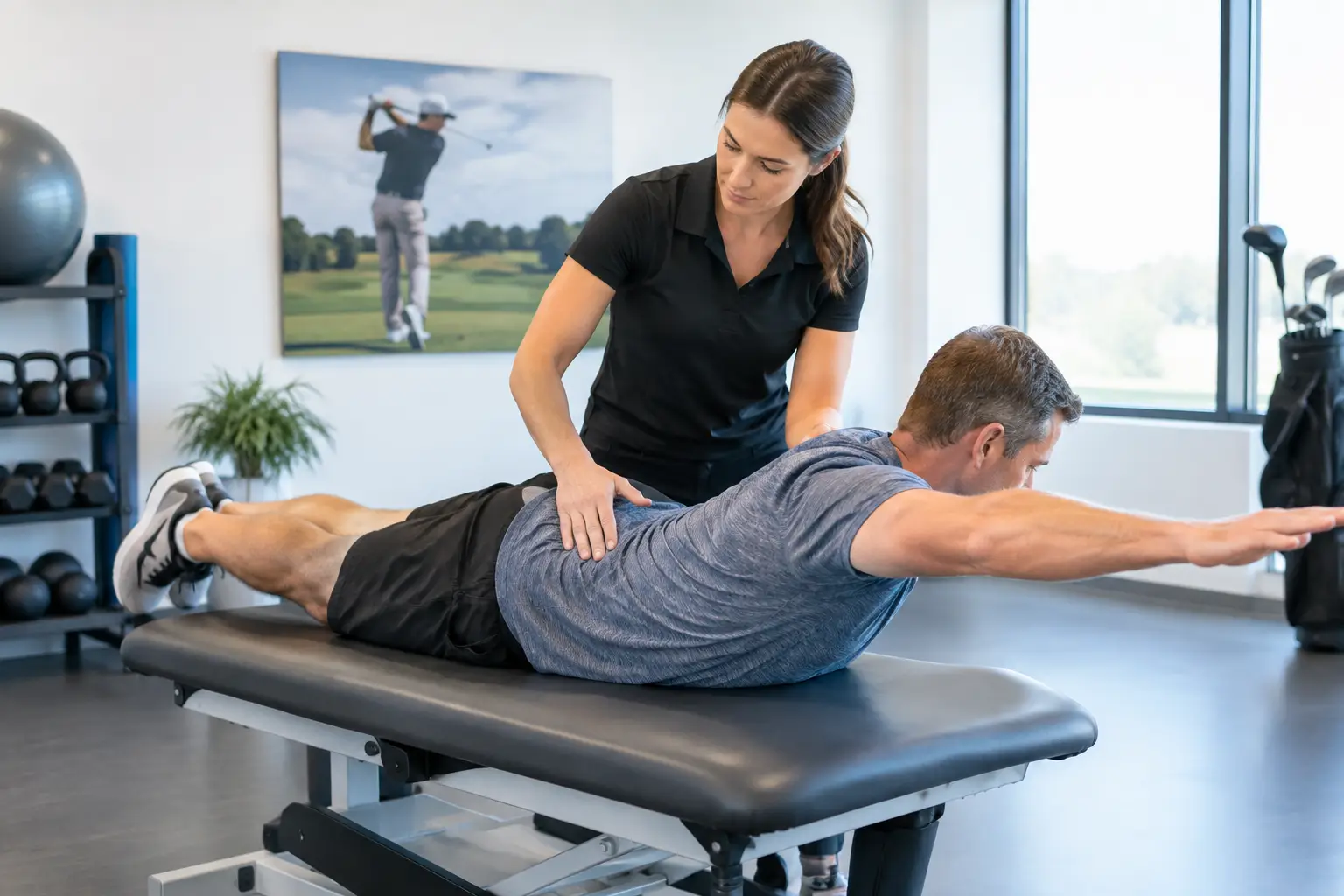
A sharp pain at impact, stiffness after 18 holes, or a back that tightens every time you rotate through your swing can take the enjoyment out of golf quickly. If you are searching for the best rehab exercises for golfers, start with the condition causing the limitation: low back pain related to golf. The right exercise plan is not a generic mobility routine. It should address your symptoms, your swing demands, and the strength needed to handle repeated rotation, side-bending, and loading.
Golf-Related Low Back Pain Is Not Always the Same Problem
Low back pain is one of the most common complaints in recreational golfers. The golf swing asks the spine to rotate quickly while transferring force from the ground, through the hips and trunk, and into the club. When the lower back ends up doing more work than it can currently tolerate, pain can develop during a round, later that day, or the following morning.
That does not mean your back is fragile or that your swing has permanently damaged it. It does mean the area may be irritated, underprepared for its current workload, or compensating for restrictions elsewhere. Hip mobility, trunk control, training volume, previous back episodes, and strength all matter.
Symptoms can vary. Some golfers feel a dull ache on one side of the low back after hitting balls. Others experience pain when bending to tee up a ball, getting out of the car after a round, or rotating into their backswing. Pain that travels below the knee, numbness, pins and needles, or noticeable leg weakness deserves a more timely assessment.
Why Golf Can Flare Up Low Back Pain
The golf swing is not inherently bad for the back. The issue is usually a mismatch between the load of the swing and the capacity of the golfer at that point in time.
A sudden increase in rounds played, long driving-range sessions, returning after a winter layoff, or trying to swing harder can all expose that mismatch. So can limited hip rotation, reduced control through the pelvis and trunk, or strength deficits in the legs. Fatigue matters too. A golfer may feel fine for the first 12 holes, then lose control of their movement as the round goes on and start relying more heavily on the low back.
It also depends on the individual. A player with a recent strain may need to temporarily reduce swing volume. Someone with recurring stiffness but no significant pain may tolerate golf while building strength around it. The goal is not to avoid rotation forever. It is to rebuild the ability to rotate, bend, carry, walk, and swing with confidence.
When Back Pain Should Be Assessed
Arrange an assessment if back pain is stopping you from playing, regularly flares after golf, or has not improved despite rest and basic stretching. An assessment is particularly useful if you have tried generic online routines but keep returning to the same point each season.
Seek urgent medical attention for new bowel or bladder changes, numbness in the saddle area, severe or worsening leg weakness, fever, unexplained weight loss, or pain following significant trauma. Those symptoms need medical evaluation rather than a self-directed golf rehabilitation plan.
A musculoskeletal assessment looks beyond the painful area. This may include how your lumbar spine, hips, thoracic spine, and shoulders move; how you control rotation; your tolerance for bending and loading; and the specific swing positions that reproduce symptoms. It should also consider your weekly golf, gym, work, and activity demands.
The Best Rehab Exercises for Golfers With Back Pain
Exercises should be selected based on the irritability of your symptoms and your current capacity. During a flare-up, the best option is often a movement that reduces stiffness and builds confidence without provoking pain. Later, rehabilitation needs to progress toward the forces involved in golf.
A useful rule is that mild, manageable discomfort can be acceptable during exercise if it settles quickly and does not leave you substantially worse later that day or the next morning. Sharp pain, escalating symptoms, or a lingering flare-up means the exercise, range, load, or volume needs to be adjusted.
1. Hip Hinge With a Dowel
Many golfers with back pain have trouble separating hip movement from lumbar movement when bending over. The hip hinge teaches you to load through the hips while maintaining a more controlled trunk position.
Hold a dowel along your back so it contacts your head, upper back, and tailbone. Soften your knees, push your hips back, and let your chest tip forward without losing the three points of contact. Return to standing by pressing through the floor and using your glutes.
Start with two to three sets of six to 10 controlled repetitions. This is not just a warm-up drill. It is a foundation for deadlifts, picking up a golf bag, and producing force through the lower body rather than repeatedly folding through the low back.
2. Side Plank Progressions
The side plank builds lateral trunk endurance and control, both of which matter when the body resists unwanted movement during a swing. It is often more relevant for golfers than endlessly repeating sit-ups or aggressive twisting drills.
Begin on your knees with your elbow beneath your shoulder and create a straight line from your head through your knees. Hold for 10 to 20 seconds without letting your hips drop or twisting forward. As this improves, progress to a full side plank from the feet or add a top-leg lift.
Perform two to four holds per side. The goal is quality, not shaking through a long hold with poor positioning.
3. Dead Bug With Controlled Exhale
A dead bug can help build trunk control while the hips move, which is useful for golfers who feel their back arch or tighten during rotation and extension. Lie on your back with hips and knees bent to 90 degrees and arms reaching upward. Gently exhale, keep your ribs from flaring, and slowly lower one heel toward the floor while reaching the opposite arm overhead.
Bring both limbs back to the start before switching sides. Use a range where you can keep your low back and ribcage controlled. Two to three sets of five to eight repetitions per side is plenty early on.
4. Split Squat or Rear-Foot Elevated Split Squat
Golf is not a back-only sport. Strong legs and hips give you a better base for force production and can reduce the need to manufacture power through the lumbar spine.
Start with a bodyweight split squat, lowering under control while keeping the front foot planted and your trunk steady. Progress by holding dumbbells, increasing range, or elevating the rear foot once the basic version is comfortable. Aim for two to four sets of six to 10 repetitions per side.
This exercise can be especially valuable if back pain appears late in a round, when lower-body endurance and control begin to fade.
5. Cable or Band Pallof Press
The Pallof press is an anti-rotation exercise, meaning your trunk resists rotation while your arms move against resistance. That may sound opposite to golf, but it builds the control needed to transfer rotational force effectively rather than letting the low back absorb it all.
Stand sideways to a cable or band, hold the handle at your chest, and press straight forward without allowing your torso to turn. Pause briefly, then return with control. Begin with two to three sets of eight to 12 repetitions per side.
Later-stage progressions can include a split stance, a small step-out, or a press combined with a controlled rotation. The right progression depends on whether basic movements and partial swings are already well tolerated.
Returning to the Course Without Guessing
Rehabilitation should eventually look like golf. If symptoms have settled and strength is improving, begin with short putting and chipping sessions, then progress to partial swings, a limited bucket of balls, and eventually a shortened round. Increase only one variable at a time: swing intensity, number of balls, holes played, or frequency each week.
Avoid the common pattern of resting until pain disappears, then jumping directly into a full round and a long range session. That approach does not rebuild capacity. A gradual return gives your back useful exposure to the movements it needs to tolerate.
At Ground Up Rehab in Hamilton, care for golf-related low back pain combines a detailed assessment, hands-on treatment when it is appropriate, and progressive rehabilitation. Joint treatment, soft tissue work, or other modalities may help reduce symptoms and improve movement tolerance, but they work best as part of a plan that restores strength and confidently returns you to the activities that matter.
If your back keeps changing the way you swing, train, or enjoy a round of golf, book an assessment. The right plan should help you move from protecting your back to trusting it again.
