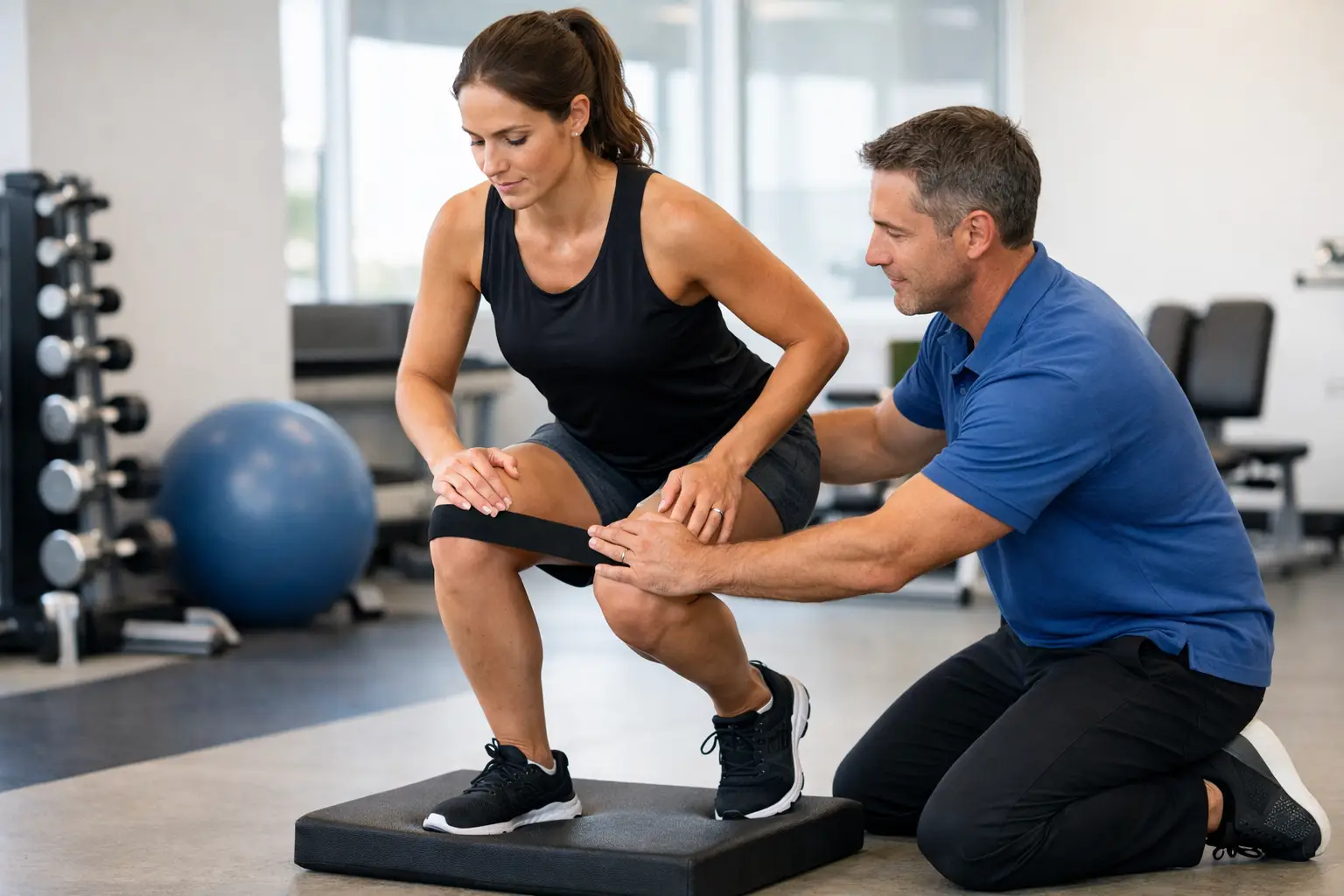
A knee that feels shaky on stairs, caves inward during squats, or aches after a run usually does not need endless stretching. It needs better control and tolerance through the whole lower body. The best exercises for knee stability build strength at the foot, ankle, hip, and trunk while teaching the knee to handle real-life tasks such as walking, lifting, running, cutting, and getting up from the floor.
Knee stability is not about keeping the joint perfectly still. Your knee is designed to bend and straighten, with a small amount of natural rotation. The goal of rehabilitation is to improve how well you control that movement and how much load your tissues can tolerate without symptoms repeatedly flaring up.
What Knee Instability Can Feel Like
People use the word “unstable” to describe several different experiences. You may feel a brief wobble when stepping off a curb, a lack of confidence going downstairs, or a sense that your knee collapses inward when you are tired. Others notice pain around the kneecap during squats, stiffness after sitting, or discomfort after a sudden increase in running, hiking, or gym training.
True giving way can sometimes occur after a ligament injury, meniscus injury, kneecap dislocation, or significant pain inhibition. But a knee can also feel unreliable because the surrounding muscles are underprepared for the task being asked of them. That distinction matters. The right plan for a runner with gradual kneecap pain is not necessarily the right plan for someone who twisted their knee in soccer last weekend.
If your knee is locked, significantly swollen, visibly deformed, unable to bear weight, or repeatedly gives way after an acute injury, seek timely medical assessment. A structured rehab assessment is also worthwhile when symptoms persist, you cannot return to work or training, or generic online exercises have not changed the problem.
The Best Exercises for Knee Stability Start With Control
The exercises below are useful because they progress from controlled strength to single-leg and task-specific loading. They are not a one-size-fits-all prescription. Mild discomfort during rehabilitation can be acceptable for some knee conditions, especially if it stays manageable and settles back to your baseline by the next day. Sharp pain, escalating swelling, catching, or a growing sense of instability means the exercise or dose needs to change.
Sit-to-Stand or Box Squat
Start with a chair, bench, or box at a height that lets you stand without a major pain spike. Sit back under control, keep your whole foot in contact with the floor, then stand by driving through the mid-foot and heel. Your knee can travel forward over your toes if it does so comfortably. The target is controlled movement, not an artificially vertical shin.
This exercise builds quadriceps strength, which is central to knee control during stairs, squatting, and deceleration. Begin with two to three sets of 8 to 12 repetitions. As it becomes easier, lower the surface, slow the descent, add a dumbbell, or progress to a single-leg variation.
Split Squat
A split squat challenges the front leg while allowing you to use the back leg for balance. Take a comfortable staggered stance, lower straight down, and let the front knee bend naturally in line with your toes. Hold onto a wall, rack, or countertop at first if balance is the limiting factor.
Split squats are particularly useful because they expose side-to-side differences that a regular squat can hide. They develop the quads, glutes, calf, and trunk control needed for walking hills, climbing stairs, lunging, and returning to sport. Start with a shorter range if needed, then gradually increase depth and load.
Step-Down
The step-down is one of the most practical knee control exercises. Stand on a low step, slowly lower the opposite heel toward the floor, then return to standing. The working knee should track generally over the middle toes. A small amount of movement inward is normal, but a sudden collapse, pelvic drop, or painful wobble suggests the step is too high or the movement is too demanding right now.
Use a low step and prioritize a slow three-second lowering phase. This trains the eccentric control needed for stairs, downhill walking, landing, and changing direction. Two or three sets of 6 to 10 controlled repetitions per side is plenty when you are starting.
Single-Leg Romanian Deadlift
Knee stability is not only a quadriceps issue. The hip muscles help control the position of the thigh beneath the pelvis, while the hamstrings contribute to knee function and overall lower-limb strength. In a single-leg Romanian deadlift, stand on one leg, soften the knee slightly, and hinge at the hip as the other leg reaches behind you. Keep your pelvis as level as you can and return by squeezing through the standing hip.
At first, use fingertips on a wall or hold a light weight in the opposite hand. This is not cheating. Removing balance as the main challenge allows you to load the hip and hamstrings with better form. Progress by adding weight before trying to make the exercise look like a circus act.
Calf Raises
Your calf and ankle influence how force moves through the knee. Limited calf strength or poor ankle control can make stairs, running, jumping, and long walks feel harder than they should. Perform calf raises on both feet first, using a wall for support. Rise fully, pause briefly at the top, and lower under control.
Progress to single-leg calf raises, then add external load. For runners and court-sport athletes, stronger calves are especially valuable because they repeatedly absorb and produce force with every stride or landing. Aim for two to four sets of 8 to 15 repetitions, depending on your current capacity.
Supported Single-Leg Balance
Balance work alone will not make a knee strong, but it can help restore confidence and coordination after pain or injury. Stand on one leg near a wall or counter. Keep the foot active, maintain a soft knee, and avoid gripping the floor with your toes. Once you can hold 20 to 30 seconds comfortably, make it more specific by reaching the free foot forward, sideways, and behind you.
For athletes, this can eventually progress to controlled hops, landing drills, and change-of-direction work. Those stages should come after you have enough basic strength and can tolerate single-leg squats or step-downs without major symptoms.
How to Progress Knee Stability Exercises
The most common mistake is changing everything at once: deeper range, more weight, more repetitions, and more training days. That is how an irritated knee stays irritated. Pick one variable to progress at a time. You might add two repetitions, increase the load slightly, use a lower box, or slow the lowering phase.
A useful starting point is strength work two to three times per week, leaving enough recovery between harder sessions. Your daily activity counts too. A tradesperson climbing ladders, a parent carrying a toddler, or a runner increasing mileage may already be placing substantial demand on the knee. Rehab has to fit around that load rather than ignore it.
The right exercise dose depends on the diagnosis, symptom irritability, training history, and goals. Someone recovering from a knee sprain may need a different progression than someone with knee osteoarthritis, patellar tendinopathy, or persistent kneecap pain. There is no prize for advancing before your knee is ready.
Why Stretching and Passive Care Are Rarely Enough
Mobility work can be helpful when a true range-of-motion restriction is affecting movement. Hands-on treatment may also reduce pain or improve short-term movement options, making it easier to start rehabilitation. At Ground Up Rehab, this may include joint treatment, deep soft tissue work, instrument-assisted soft tissue therapy, cupping, shockwave therapy, or Class IV laser therapy when clinically appropriate.
Those tools are not the finish line. Lasting improvement usually requires progressive loading - building the strength, control, and confidence to tolerate the activities that matter to you. If squatting, running, stairs, work duties, or sport keeps exposing the same problem, your program needs to prepare you for that exact demand.
When an Individual Assessment Makes Sense
A good knee assessment looks beyond the painful spot. It considers how your symptoms began, what aggravates them, your movement quality, strength, range of motion, training volume, and the demands of your work or sport. It may also include testing your ability to squat, step down, balance, hop, or change direction, depending on your goals.
If your knee feels unstable, painful, weak, or unreliable, do not settle for a generic exercise sheet that does not match your situation. Book an assessment with Ground Up Rehab in Hamilton to get a clear plan for rebuilding capacity and returning to the activities you want to do with more confidence.
